
A loose bolt can become much more than a maintenance issue. In machinery, automotive assemblies, power transmission equipment and other industrial applications, unwanted fastener movement can affect reliability, increase maintenance requirements and, in critical assemblies, create safety concerns.
This is where threadlocker plays an important role.
Threadlocker is an adhesive material applied to threaded fasteners such as bolts, screws and studs to help prevent unwanted loosening. Anaerobic threadlockers work by curing when confined between mating metal surfaces, creating a solid material within the threaded joint.
Depending on the formulation and strength grade, a threadlocker can do more than help lock a fastener. It can also help seal threaded joints, protect against thread corrosion, provide controlled locking strength and support more consistent fastening.
This guide explains what threadlocker is, how threadlocker works, the different types of threadlocker, how to choose the right grade, how to apply it, and where threadlocking technology is used.
What Is a Threadlocker?
A threadlocker, also called a thread locking adhesive or threadlocking adhesive, is used to secure threaded fasteners and help prevent them from loosening during service.
It is applied to the threads before assembly. Once the fastener is assembled, an anaerobic threadlocker cures within the confined threaded interface.
Unlike conventional mechanical locking methods that add or modify a physical component of the fastening system, threadlocker works directly within the threaded joint.
Threadlockers are available in different strengths and formulations. The appropriate product depends on factors such as the required locking strength, fastener size, operating conditions and whether the assembly needs to be disassembled later.
Why Do Bolts and Fasteners Loosen?
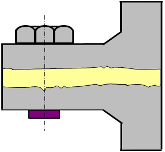
A properly tightened bolt creates tension in the fastener and friction between the mating surfaces. When torque is applied to a nut on a bolt, the bolt begins to stretch as the applied load increases, creating tension in the bolt.
During operation, however, a bolted joint can experience forces that affect this condition.
Common factors that can contribute to loosening include:
- Vibration
- Shock or impact
- Bending of the joint
- Differential thermal expansion
- Changes in internal pressure
- Repeated movement of the assembly
The SUPEX technical presentation specifically identifies joint bending, differential thermal expansion, shock or impact and internal pressure changes as factors associated with bolted-joint loosening.
This is why simply tightening a bolt may not always be enough for demanding applications. The fastening system also needs to be selected with the operating environment in mind.
How Does Threadlocker Work?
One of the most important characteristics of an anaerobic threadlocker is its curing mechanism.
An anaerobic resin can remain liquid when exposed to air. When it is confined between mating metal surfaces and air is excluded, it cures into a tough solid material.
The basic process is:
Apply → Assemble → Air is excluded → Threadlocker cures → Threaded joint is secured
Before assembly, the threadlocker remains in a liquid state because oxygen is present. After the bolt and nut are assembled, the material is confined between the metal threads. The absence of air allows the adhesive to cure.
This makes anaerobic threadlocker particularly suitable for threaded metal fasteners.
What Is an Anaerobic Threadlocker?
An anaerobic threadlocker is a threadlocking adhesive that cures in an oxygen-depleted, confined environment between suitable mating surfaces.
This distinguishes it from many conventional adhesives that cure through exposure to moisture, heat, evaporation or another external mechanism.
The anaerobic principle is especially useful for threaded fasteners because the adhesive can be applied as a liquid and then cured inside the assembled threaded interface.
The result is a solid material occupying the space between the mating threads.
Threadlocker vs. Mechanical Locking Methods
Traditional methods of preventing fastener loosening include a range of mechanical solutions.
Examples include:
- Washers
- Split-ring washers
- Tooth-lock washers
- Double nuts
- Deformed threads
- Serrated bolt heads
- Elastic-stop nuts
The SUPEX presentation classifies mechanical fasteners and anaerobic threadlockers as different approaches to fastening and shows several conventional mechanical locking methods.
Mechanical locking methods can be effective, but fastening design may also need to consider loosening, leakage, corrosion and variation in bolt tension. These are specifically identified as considerations in the presentation.
A threadlocker provides an alternative by placing the locking material directly into the threaded interface.
Why Consider Threadlocker?
Depending on the formulation and application, threadlocking can provide several functions within the same joint:
- Help prevent unwanted fastener loosening
- Help seal threaded interfaces
- Help protect threads against corrosion
- Provide controlled lubricity
- Support more consistent bolt tension
- Provide controlled locking strength
- Reduce the need for additional mechanical locking components in some designs
These benefits are highlighted in the SUPEX technical presentation.
Types of Threadlocker
Threadlockers are generally selected according to the strength and service requirements of the fastener.
1. Low-Strength Threadlocker
Low-strength threadlocker is intended for smaller fasteners and applications where regular adjustment or removal may be required.
Typical applications can include:
- Small screws
- Instruments
- Small mechanical assemblies
- Components requiring frequent adjustment
SUPEX currently lists Supex 222 as an example of a low-strength threadlocking product.
2. Medium-Strength Threadlocker
Medium-strength threadlocker is designed for applications where the fastener needs reliable resistance to loosening while still allowing future disassembly with appropriate tools.
Typical applications include:
- Automotive components
- Machinery
- General industrial assemblies
- Equipment requiring periodic maintenance
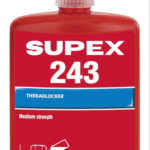
SUPEX lists Supex 242 and Supex 243 as examples of medium-strength threadlockers.
3. High-Strength Threadlocker
High-strength threadlocker is intended for applications where maximum resistance to loosening is required and routine disassembly is not expected.
It may be considered for:
- Heavy machinery
- Engines
- Permanent or semi-permanent assemblies
- High-load threaded connections
SUPEX currently lists Supex 270 and Supex 272 as examples of high-strength threadlockers.
The exact removal method and operating limits should always be checked against the technical information for the specific product.
4. Wicking Threadlocker
Wicking-grade threadlocker is a low-viscosity formulation designed to penetrate into an already assembled threaded joint.
This makes it useful when disassembly is undesirable or when applying adhesive after assembly is more practical.
SUPEX lists Supex 290 as an example of a wicking-grade threadlocker.
How to Choose the Right Threadlocker
Choosing a threadlocker should not be based on colour or strength alone.
Consider the following factors before selecting a product.
1. Required Strength
Determine how much resistance to loosening the assembly requires.
- Low strength: frequent adjustment or removal
- Medium strength: serviceable assemblies
- High strength: assemblies where removal is not normally expected
- Wicking grade: already assembled fasteners
2. Need for Disassembly
If technicians will need to remove the fastener during routine maintenance, a serviceable or removable grade may be more appropriate.
For assemblies that are not expected to be disassembled, a higher-strength product may be considered.
3. Fastener Size
The size and design of the threaded joint can influence the selection of threadlocker.
Small fasteners, large bolts and different thread geometries may require different formulations or application methods.
4. Operating Environment
Consider:
- Temperature
- Vibration
- Shock
- Exposure to oils or chemicals
- Moisture
- Pressure
- Corrosive conditions
The selected product should be suitable for the actual operating environment.
5. Substrate and Surface Condition
The condition and material of the mating surfaces can affect curing and performance.
For reliable results, threads should be properly prepared according to the manufacturer’s instructions.
Threadlocker Application: How to Apply Threadlocker Correctly
Correct application is just as important as choosing the correct threadlocker.
Step 1: Clean the Threads
Remove oil, grease, dirt and other contaminants from the threaded surfaces.
The current SUPEX application guidance recommends clean surfaces free from grease before bonding.
Step 2: Apply the Threadlocker
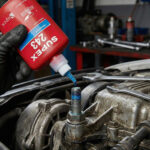
Apply an appropriate amount of threadlocker to the threaded area.
The exact application method can depend on whether the fastener is installed through a hole, into a blind hole or is already assembled.
Step 3: Assemble the Fastener
Assemble the components while the threadlocker is still wet.
This allows the liquid material to distribute through the mating threads.
Step 4: Allow the Threadlocker to Cure
Allow sufficient time for the threadlocker to develop its required strength before placing the assembly under service load.
Curing time varies according to the product, materials, temperature, gap and other conditions. The current SUPEX article states that full curing can range from 24 to 72 hours for its stated application guidance.
Always follow the technical data and application instructions for the specific product being used.
How Long Does Threadlocker Take to Cure?
There is no single curing time that applies to every threadlocker.
Cure behaviour can vary depending on:
- Threadlocker formulation
- Strength grade
- Metal type
- Surface condition
- Temperature
- Thread clearance
- Use of an activator or accelerator
The current SUPEX guidance gives a general full-cure range of 24 to 72 hours for the stated application conditions.
For critical applications, the product’s technical data sheet should take precedence over a general curing estimate.
How to Choose the Right Threadlocking glue
| Application | Recommended Strength |
|---|---|
| Small screws | Low |
| Automotive | Medium |
| Heavy machinery | High |
| Preassembled fasteners | Wicking |
What Are the Benefits of Threadlocker?
Threadlocker can provide several benefits beyond simply holding a bolt in place.
Prevents Unwanted Fastener Loosening
This is the primary reason threadlocker is used.
By curing within the threaded interface, threadlocker helps resist movement that could cause the fastener to loosen during service.
Helps Seal Threaded Joints
The cured material can occupy the spaces between mating threads, helping seal the threaded interface.
The SUPEX presentation identifies sealing against leakage and internal pressure as a benefit of threadlocking.
Helps Protect Against Thread Corrosion
Threadlocker can help protect the threaded interface against corrosive exposure.
The presentation specifically identifies prevention of thread corrosion as one of the benefits of threadlocking.
Supports Consistent Bolt Tension
Torque applied to a fastener does not translate directly into bolt tension because friction influences the relationship between torque and tension.
The presentation highlights controlled lubricity as a way of supporting more consistent bolt tension.
Provides Controlled Locking Strength
Threadlockers can be formulated for different strength requirements.
This allows the locking system to be matched to the application, including assemblies that need to remain serviceable and assemblies where disassembly is not normally anticipated.
Can Simplify the Fastening System
In suitable applications, liquid threadlocking can provide a locking function without requiring an additional mechanical locking component.
The result can be a simpler fastening arrangement and potentially lower inventory requirements.
Threadlocker for Vibration and Shock Applications
Vibration is a major consideration when designing reliable threaded joints.
A fastener can be correctly tightened during assembly and still experience movement during service if the joint is subjected to repeated transverse forces or shock.
The SUPEX technical presentation includes a transverse shock machine test comparing several fastening arrangements. The test setup includes a test specimen, restrained square washer, sintered bronze bearing and strain gauges.
The comparison includes:
- Unassisted bolt and nut
- Bolt with split-ring washer and nut
- Bolt with tooth-lock washer and nut
- Bolt with elastic-stop nut
- Bolt with SUPEX liquid threadlocker and nut
This type of testing is particularly relevant when selecting a fastening solution for equipment exposed to vibration or repeated shock.
Threadlocker Applications
Threadlockers can be used across a wide range of threaded assemblies.
The SUPEX technical presentation identifies applications including:
Power Transmission
Threadlocking can be considered for threaded connections used in power transmission equipment where maintaining fastener security is important.
Foundation and Anchor Bases
Threadlocker can be used as part of the fastening strategy for threaded connections in foundation and anchor-base applications.
Cross-Arm Joints and Brackets
Threadlocking is applicable to threaded joints used in brackets and structural connections.
High-Vibration Zones
High-vibration areas are an important application because repeated movement can contribute to fastener loosening.
Lower-Leg and Ground Bracing
Threadlocking can be incorporated into threaded fastening systems used in structural bracing.
Splice Plates and Diagonal Bracing
Threadlockers can also be considered for threaded connections in structural assemblies.
Track Applications
The SUPEX presentation also identifies track applications as an area where threadlocking technology is used.
Can Threadlocker Be Removed?
Yes, depending on the strength grade and product formulation.
Low- and medium-strength threadlockers are generally selected where future disassembly is required.
Higher-strength threadlockers are intended for assemblies where disassembly is less frequent or not normally expected.
For high-strength products, controlled heat may be required to assist removal. The exact temperature and procedure should always be taken from the technical documentation for the specific product rather than applying a universal temperature range.
After disassembly, old cured material should be removed from the threads and the surfaces cleaned before reassembly with fresh threadlocker.
Can Threadlocker Be Reused?
Cured threadlocker should not be treated as reusable adhesive.
When a threaded joint has been disassembled, the old cured material should be cleaned from the mating threads. Fresh threadlocker should then be applied before reassembly.
This helps ensure that the new assembly has the intended locking and sealing characteristics.
Is Threadlocker Waterproof?
Threadlocker can provide sealing within a threaded joint, but water resistance and sealing performance depend on the specific formulation and application.
The SUPEX presentation identifies sealing against leakage and internal pressure as a benefit of threadlocking.
For applications involving water, oil, fuel, coolant, chemicals or pressurised fluids, select a product whose technical documentation specifically confirms suitability for the intended medium and conditions.
What Temperature Can Threadlocker Withstand?
Temperature resistance is product-specific.
Different threadlockers are formulated for different operating conditions, so a general temperature range should not be applied to every product.
When selecting a threadlocker for high-temperature applications, check:
- Continuous operating temperature
- Peak temperature
- Required strength at operating temperature
- Exposure duration
- Chemical environment
- Substrate material
Always use the technical data for the specific grade when making a product-selection decision.
Threadlocker vs. Washers: Which Should You Use?
There is no single locking method that is correct for every fastening application.
Mechanical locking methods such as washers and lock nuts may be appropriate in some assemblies. Threadlocker can be advantageous where the design calls for locking within the threaded interface, sealing, corrosion protection or controlled locking strength.
The choice should be based on the joint design, service conditions, maintenance requirements and applicable engineering standards.
For demanding applications, threadlocker can also be considered as part of a broader fastening strategy rather than as a universal replacement for every mechanical locking method.
Why Use Threadlocker in Industrial Applications?
Industrial equipment often operates under conditions that can challenge threaded joints.
Vibration, impact, thermal changes, pressure variations and repeated mechanical loading can all contribute to fastening problems.
A properly selected threadlocker can help address several of these concerns simultaneously:
- Fastener loosening
- Thread leakage
- Thread corrosion
- Bolt-tension consistency
- Maintenance requirements
- Controlled disassembly
This makes threadlocking technology particularly relevant to equipment where reliability and maintenance efficiency are important.
SUPEX Threadlocking Solutions
SUPEX offers threadlocking products in different strength categories and formulations for different fastening requirements.
The current SUPEX range referenced in its threadlocker content includes:
- SUPEX 222 – low-strength threadlocking
- SUPEX 242 / 243 – medium-strength threadlocking
- SUPEX 270 / 272 – high-strength threadlocking
- SUPEX 290 – wicking-grade threadlocking
The right product should be selected based on the fastener, required strength, operating environment and disassembly requirements.
For application-specific recommendations, consult the relevant product technical documentation or contact the SUPEX technical team.
How to apply Supex threadlocking glue
APPLICATION TEMPERATURE:+5 ℃ to +45 ℃
1. For best results, the surface of the material to be bonded should be clean and free of grease.
2. To ensure fast and reliable curing, one bonding surface is coated with activator and the other surface is coated with glue. The parts
should be assembled immediately within 15 minutes.
3. It is recommended that the gap between the adhesive layer is 0.1mm. When the gap of the glue layer is too large (≤0.5mm) or fast
curing is required, an accelerator can be used. The components must be assembled quickly within one minute.
4. Excess threadlocker adhesive can be removed with organic solvents.
5. The bonded parts should be fixed until the adhesive is initially set.
6. After the adhesive has reached full strength, it can bear the load (full curing time is between 24 and 72 hours).
STORAGE AND SHELF LIFE
12 months in unopened packages in a cool and dry storage place at temperatures between +5 oC and 27 C, humidity between 30% and 70%. Optimal storage is at the lower half of this temperature and humidity range. To prevent contamination of unused threadlockers, do not return any material to its original container
PACKING
50mL, 250mL, 1000mL. Different packages are available
SAFETY
Keep out of reach of children. Before operation, please carefully read the specifications of products and material, and instructions on the package of container. For more information
about safety, please refer to the MSDS
Frequently Asked Questions About Threadlocker
What is threadlocker used for?
Threadlocker is used on threaded fasteners such as bolts, nuts, screws and studs to help prevent unwanted loosening. Depending on the formulation, it can also help seal the threaded joint and protect the thread interface.
How does threadlocker work?
Anaerobic threadlocker is applied as a liquid and cures when confined between mating metal surfaces where air is excluded. The cured material occupies the threaded interface and helps secure the fastener.
What is an anaerobic threadlocker?
An anaerobic threadlocker is a threadlocking adhesive that cures in the absence of air when confined between suitable mating surfaces, particularly metal threaded components.
Does threadlocker prevent bolts from loosening?
Threadlocker is designed to help prevent unwanted loosening of threaded fasteners. It is particularly relevant to assemblies where vibration, shock or other operating forces can contribute to loosening.
What are the different types of threadlocker?
Common categories include low-strength, medium-strength, high-strength and wicking-grade threadlockers.
Which threadlocker should I use?
The choice depends on the required locking strength, fastener size, operating conditions and whether the assembly needs to be removed later.
What is the difference between low-, medium- and high-strength threadlocker?
Low-strength products are generally intended for easier removal and smaller fasteners. Medium-strength products provide a balance between resistance to loosening and serviceability. High-strength products are intended for applications where disassembly is not normally expected.
Can threadlocker seal a bolt?
Threadlocker can help seal the threaded interface. The suitability of a particular product for preventing leakage or resisting a specific fluid or pressure should be confirmed from its technical data.
Can threadlocker prevent corrosion?
Threadlocker can help protect the threaded interface from corrosion, and corrosion prevention is identified as one of the benefits of threadlocking in the SUPEX technical presentation.
How long does threadlocker take to cure?
Cure time depends on the product, substrate, temperature, gap and other conditions. SUPEX’s current application guidance states a full curing period of approximately 24–72 hours for the specified application conditions.
Can threadlocker be removed?
Yes. Removability depends on the strength grade. Low- and medium-strength products are generally selected for serviceable assemblies, while high-strength products may require additional measures for disassembly.
Can cured threadlocker be reused?
No. After a threaded joint is disassembled, the old cured material should be cleaned from the threads and fresh threadlocker applied during reassembly.
Where is threadlocker used?
Threadlocker can be used in a wide range of applications, including machinery, automotive assemblies, power transmission equipment, structural fastening, high-vibration zones, bracing and track applications. The SUPEX presentation specifically identifies power transmission, foundation and anchor bases, cross-arm joints and brackets, high-vibration zones, bracing, splice plates and track applications.
Conclusion
A reliable threaded joint requires more than simply tightening a bolt.
Vibration, shock, thermal expansion, joint movement and pressure changes can all challenge fastener security during operation. Threadlocker provides a way to address these challenges by curing within the threaded interface and helping prevent unwanted fastener movement.
An anaerobic threadlocker starts as a liquid and cures when confined between mating metal surfaces. Depending on the formulation, it can provide controlled locking strength while also helping seal the threaded joint, protect the thread interface and support more consistent fastening.
The most important step is selecting the right threadlocker for the application.
Consider the required strength, fastener size, operating conditions, surface condition and future disassembly requirements before choosing a product.
For applications where vibration, shock or recurring fastener loosening is a concern, threadlocking can be an effective part of a well-designed fastening strategy.
Need help selecting a threadlocker for your application? Contact SUPEX for technical guidance on the appropriate threadlocking solution.