
Windows are exposed to rain, humidity, heat, dust and repeated temperature changes throughout their service life. For contractors, window fabricators and installation teams, the sealant used around the window frame can therefore have a significant impact on the quality and durability of the finished installation.
A good window silicone sealant should create a reliable seal between the window frame and surrounding building materials while accommodating the movement that occurs as materials expand, contract and respond to environmental conditions.
But choosing a window sealant is not simply about picking a product labelled “silicone.”
The right choice depends on the window material, joint location, exposure to water and weather, required flexibility, surface compatibility, finishing requirements and the manufacturer’s technical specifications.
This guide explains what to look for in a window silicone sealant, where window sealants are used, how to apply them correctly, and what contractors and fabricators in Tamil Nadu should consider before selecting a product.
What Is Window Silicone Sealant?
A window sealant is used to seal the joint between a window frame and the surrounding surface or between components of a window assembly.
These joints may involve materials such as:
- uPVC
- Aluminium
- Glass
- Wood
- Concrete
- Masonry
- Metal
- Other building materials
The purpose of the sealant is to close gaps and help protect the joint from moisture, air and environmental exposure.
Silicone sealants are widely used for window and glazing applications because silicone formulations can offer flexibility and weather resistance. However, not every window sealant is silicone.
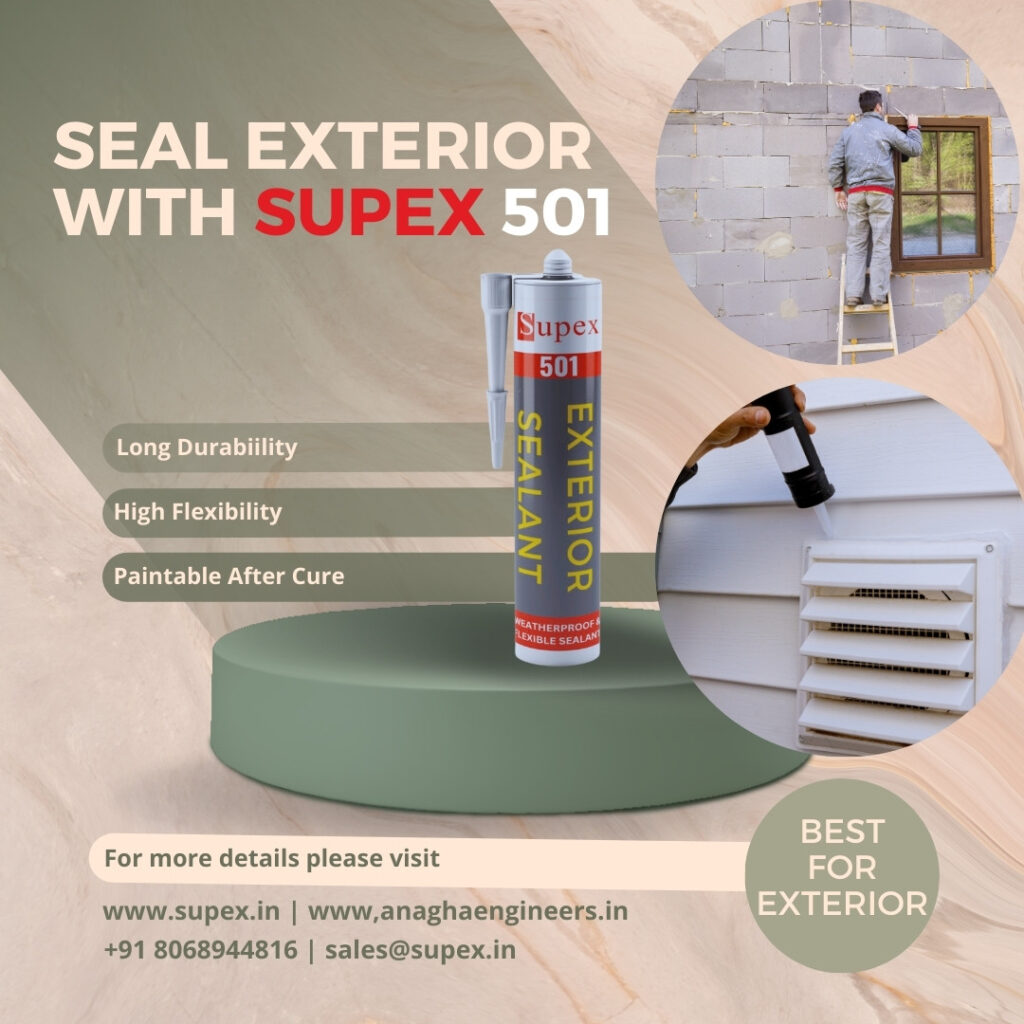
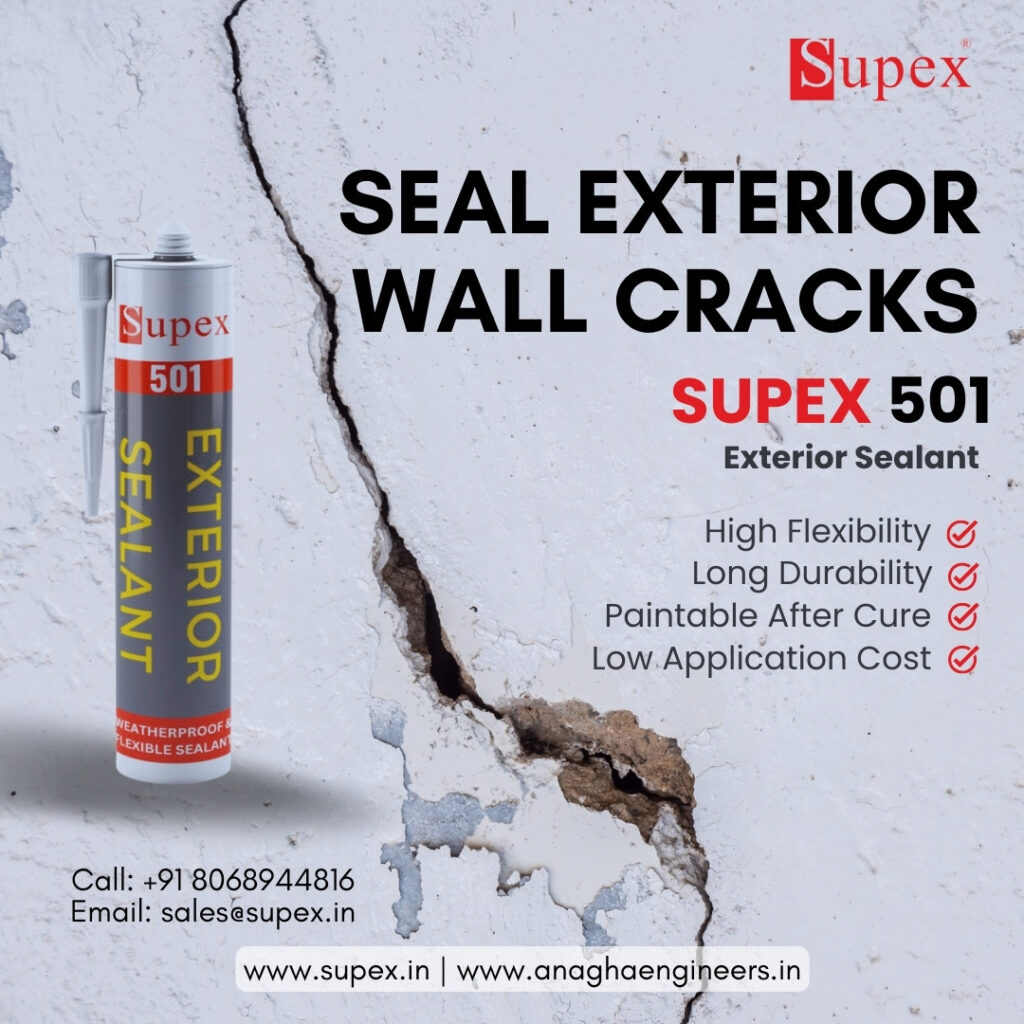
For example, the current SUPEX product information describes SUPEX 501 Exterior Window Sealant as a paintable acrylic gap filler, with applications including uPVC, wood, concrete and other building materials.
Therefore, contractors should select the product based on its actual formulation and technical data rather than the generic term “window silicone sealant.”
Why Is Sealant Important for Window Installation?
A window joint can be exposed to substantially different conditions from the surrounding wall.
Rainwater can reach the exterior joint. Temperature changes can cause the frame and surrounding material to move. Dust and moisture can enter poorly sealed gaps.
A suitable sealant helps create a continuous barrier around the joint.
For professional installers, the key objectives are:
- Reliable gap sealing
- Moisture protection
- Good adhesion
- Flexibility where joint movement is expected
- Resistance to outdoor exposure
- A clean finished appearance
- Long-term durability appropriate to the application
The sealant should therefore be treated as part of the window installation system, rather than simply as a material used to fill a visible gap.
Where Is Window Sealant Used?
Window sealant can be used in several areas of a window installation.
Window Frame Joints
Sealant can be applied around the perimeter of uPVC, aluminium or other window frames to close the gap between the frame and the surrounding surface.
Glass-to-Frame Joints
Glazing applications may require sealing between glass and the frame or between adjacent components.
The exact product must be selected for the materials and glazing system involved.
Exterior Window Joints
Exterior joints are exposed to rain, sunlight and temperature changes.
These applications require a sealant whose technical properties are suitable for the expected outdoor exposure.
Door and Frame Joints
Similar sealing requirements can occur around exterior doors and door frames.
Construction and Façade Joints
Depending on the product, sealants may also be used for façade joints, panel joints, masonry joints and other building-envelope applications.
SUPEX’s current 501 product information lists applications including uPVC and PVC window and door joints, HVAC duct sealing, wall and ceiling gaps, concrete expansion joints and sealing/bonding of materials including aluminium, GI sheets and MS panels.
What Should You Look for in a Window Silicone Sealant?
When selecting a window silicone sealant, contractors and fabricators should evaluate the actual requirements of the joint.
1. Adhesion to the Window Material
The sealant needs to be compatible with the surfaces being joined or sealed.
Common window materials include:
- Aluminium
- uPVC
- Glass
- Wood
- Concrete
- Masonry
Always check the manufacturer’s compatibility information before using a sealant on a particular substrate.
2. Flexibility
Windows and surrounding building materials can experience movement caused by temperature changes and structural movement.
A flexible sealant can accommodate appropriate joint movement better than a rigid filler.
For SUPEX 501, the current technical information specifies an elongation at break of ≥100% and describes the product as a flexible gap filler.
3. Water Resistance
Exterior window joints are exposed to rain and moisture.
The selected sealant should have sealing properties appropriate to the expected water exposure.
However, “waterproof” should not be treated as sufficient evidence by itself. Contractors should consider the complete joint design, substrate preparation and application quality.
4. Weather and UV Exposure
An exterior window sealant may be exposed to:
- Sunlight
- UV radiation
- Rain
- Humidity
- Temperature fluctuations
If the joint is externally exposed, verify that the selected product is specifically designed for those conditions.
5. Paintability
Paintability can be an important requirement where the sealed joint needs to match surrounding architectural finishes.
This is one area where acrylic and silicone products can differ.
The current SUPEX 501 product information describes it as a paintable acrylic gap filler, making paintability a relevant advantage for applications where the joint will subsequently be finished.
6. Application and Tooling
For high-volume window installation, the sealant should be practical to dispense and tool.
Cartridge-based application using a sealant gun allows installers to control the bead and produce a cleaner finish.
Silicone Sealant vs Acrylic Sealant for Windows
One of the most important decisions is choosing between silicone and acrylic technology.
Neither should automatically be considered the “best” for every window application.
| Requirement | Silicone Sealant | Acrylic Sealant |
|---|---|---|
| Exterior exposure | Often suitable, depending on formulation | Product-dependent |
| Flexibility | Generally high | Formulation-dependent |
| Paintability | Often limited | Common advantage |
| Glass/aluminium sealing | Common application | Product-dependent |
| Interior gap filling | Suitable formulations available | Common application |
| Water exposure | Formulation-dependent | Formulation-dependent |
| Selection priority | Joint and exposure requirements | Joint and finishing requirements |
The correct choice should always be based on the product’s technical data and the requirements of the joint.
For SUPEX 501 specifically, the current product page identifies the product as an acrylic sealant rather than silicone.
Important: Do Not Choose a Window Sealant by Name Alone
A product being marketed as a “window sealant” does not automatically tell you:
- Its chemical base
- Its movement capability
- Its substrate compatibility
- Its paintability
- Its temperature resistance
- Its curing behaviour
- Its suitability for glazing
For professional projects, always check the technical data sheet.
SUPEX 501 Exterior Window Sealant
SUPEX 501 is positioned by SUPEX as an exterior window sealant and flexible gap-filling product.
The current product information identifies its base as acrylic and lists applications involving uPVC, PVC, concrete, aluminium, GI sheets, MS panels and other building materials.
Its published technical properties include:
- Acrylic base
- Specific gravity: 1.60 ± 0.03 g/cm³
- Tack-free time: 15–60 minutes at 25°C and 50% RH
- Cure rate: approximately 2 mm/24 hours
- Tensile strength at break: ≥0.1 MPa
- Elongation at break: ≥100%
- Modulus at 100% elongation: >0.2 MPa
The product is available in 500 g cartridges, 450 g sausages and 25 kg drums according to the current product information.
Window Sealant Applications for Tamil Nadu
Tamil Nadu has a large and diverse construction market, including residential construction, commercial buildings, industrial facilities and infrastructure projects.
For window installers, the important consideration is not simply the location but the exposure conditions of the individual project.
Projects in coastal or high-humidity areas may experience significant moisture exposure. Exterior installations are also exposed to sunlight, rain and temperature variation.
For this reason, contractors should select a window sealant according to:
- Interior or exterior location
- Window-frame material
- Surrounding substrate
- Joint width and depth
- Expected joint movement
- Moisture exposure
- Required finish
- Paint requirements
- Expected service conditions
This approach is more reliable than selecting a product solely because it is advertised as a “window silicone sealant.”
How to Apply Window Sealant Correctly
Even a high-quality sealant can perform poorly if the joint is incorrectly prepared.
Step 1: Clean the Surface
Remove:
- Dust
- Dirt
- Oil
- Grease
- Loose particles
- Old sealant
The current SUPEX application guidance recommends clean, dry surfaces free from contaminants before application.
Step 2: Prepare the Joint
Check the joint dimensions and make sure the sealant can be applied consistently throughout the gap.
For larger or movement-sensitive joints, follow the manufacturer’s joint-design recommendations.
Step 3: Prepare the Cartridge
Cut the nozzle to the required opening and load the cartridge into a suitable sealant gun.
The nozzle opening should be appropriate for the joint size.
Step 4: Apply a Continuous Bead
Apply the sealant steadily so that the joint is filled without gaps or trapped air.
A continuous bead is important for creating a consistent seal.
Step 5: Tool the Sealant
Tool the sealant within the recommended tooling period to create the desired finish and ensure proper contact with the joint surfaces.
The SUPEX 501 instructions recommend tooling within the applicable tack-free period.
Step 6: Allow the Sealant to Cure
Do not expose the joint to unnecessary stress or movement before adequate curing.
SUPEX 501 has a published cure rate of approximately 2 mm per 24 hours, although actual curing can vary with conditions and joint geometry.
Common Window-Sealing Mistakes to Avoid
Applying Sealant to a Dirty Surface
Dust and grease can interfere with adhesion.
Better approach: clean and prepare the substrate before application.
Applying an Incompatible Product
A sealant may not adhere properly to every material.
Better approach: check substrate compatibility before starting the project.
Using the Wrong Product for the Joint
A product designed for interior gap filling may not be appropriate for an exposed exterior joint.
Better approach: select according to exposure, movement and substrate.
Applying Too Much Sealant
An unnecessarily thick bead can affect curing and finishing.
Better approach: design and fill the joint appropriately.
Moving the Joint Before Cure
Premature movement can affect the developing seal.
Better approach: allow sufficient cure time before exposing the joint to service conditions.
Window Silicone Sealant for Contractors and Fabricators
For professional window installers, the selection process is different from that of a homeowner buying a general-purpose sealant.
A fabricator may be installing hundreds or thousands of windows and needs:
- Consistent product quality
- Predictable application
- Suitable packaging
- Reliable supply
- Technical documentation
- Product availability
- Application support
This makes the supplier relationship important alongside the sealant itself.
SUPEX provides window and construction sealing products and states that it offers technical support, product assistance and pan-India delivery.
For larger projects, contractors and procurement teams should discuss product selection, packaging and application requirements directly with the supplier.
Window Sealant for Dealers and Building-Material Suppliers
Window sealants can also be an important product category for hardware dealers and construction-material suppliers serving:
- Window fabricators
- Aluminium contractors
- uPVC installers
- Glass and glazing contractors
- Builders
- Interior contractors
- Construction companies
The most suitable product portfolio will depend on the customers and applications served in the local market.
For dealers, packaging, colour availability, product consistency and supply reliability can be as important as technical performance.
Frequently Asked Questions About Window Silicone Sealant
What is window silicone sealant?
Window silicone sealant is a flexible sealing material used around window frames, glazing joints and other window-related joints. Silicone is one type of sealant technology; other formulations, such as acrylic sealants, are also used for window and building applications.
Which sealant is best for windows?
There is no single best sealant for every window.
The appropriate product depends on the window material, joint location, exposure to water and weather, movement requirements, paintability and other project conditions.
Can silicone sealant be used on aluminium windows?
Silicone formulations are commonly used in aluminium and glazing applications, but substrate compatibility should always be confirmed for the specific product.
SUPEX also offers products specifically positioned for aluminium and glazing applications.
Can window sealant be used on uPVC?
Yes, suitable window sealants can be used on uPVC window joints. The manufacturer’s compatibility information should be checked before application.
SUPEX 501 lists uPVC and PVC window and door joints among its applications.
Is window silicone sealant waterproof?
Suitable silicone sealants can provide highly water-resistant sealing, but performance depends on the formulation, joint design, substrate preparation and application.
The product should be selected according to the actual water and weather exposure.
Can window sealant be painted?
Paintability depends on the formulation.
Many silicone sealants are not intended to be painted, while acrylic sealants can offer paintability.
SUPEX 501 is currently described as a paintable acrylic gap filler.
How long does window sealant take to cure?
Curing time varies by formulation, joint thickness, temperature and humidity.
For SUPEX 501, the published cure rate is approximately 2 mm per 24 hours.
How do you apply window sealant?
Clean and dry the surfaces, prepare the joint, apply a continuous bead with a sealant gun, tool the sealant within the recommended period and allow adequate curing before exposing the joint to service conditions.
Can window sealant be used outdoors?
Yes, products specifically designed for exterior applications can be used outdoors. Always check the manufacturer’s weather, UV and substrate compatibility data before use.
What colour window sealant should I use?
The choice depends on the window frame and architectural finish.
White, black, clear and other colours can be used to achieve either a contrasting or less visible joint. SUPEX lists multiple colour options for its 501 product.
Choosing the Right Window Sealant for Your Project
The best window sealing solution is the one that matches the joint, substrate and service environment.
Before selecting a product, ask:
- What material is the window frame made from?
- Is the joint indoors or outdoors?
- Will the joint be exposed to rain or continuous moisture?
- How much movement is expected?
- Does the joint need to be painted?
- What finish and colour are required?
- How quickly does the installation need to be completed?
- What does the product technical data sheet specify?
These questions help contractors avoid choosing a sealant based only on a generic product label.
Conclusion
A window sealant is an important part of a professional window installation. It helps close gaps around frames and joints while protecting the assembly from the conditions it will encounter during service.
For window silicone sealant applications, selection should be based on the actual requirements of the joint—not simply on the word “silicone.”
Consider the substrate, exposure, movement, water resistance, paintability, curing requirements and application method before choosing a product.
For Tamil Nadu contractors, window fabricators, glazing professionals and construction-material suppliers, a technically appropriate sealant can help improve installation quality and reduce avoidable sealing problems.
Looking for the right window sealant for your project? Contact SUPEX for product selection, technical support or a project-specific recommendation.