
Metal Roof Sealant: How to Choose the Best Sealant for Roof Sheets and Leaks
A leaking metal roof can damage stock, equipment, ceilings, and building structures. Even a small gap around a screw or roof joint can let rainwater enter during heavy rainfall.
The right metal roof sealant helps close these gaps and protect your roof from water ingress. It can also reduce repeat repairs when the product suits the roof material and joint movement.
But which sealant should you choose? Polyurethane (PU), silicone, and MS polymer sealants all have different strengths.
This guide explains how to choose the best sealant for metal roof sheets, fix common leak points, and select a suitable Supex product for your application.
What Is Metal Roof Sealant?
Metal roof sealant is a flexible material used to close gaps and joints in metal roofing systems. It helps prevent water from entering through seams, fasteners, flashing, and roof-to-wall connections.
It is commonly used on:
Industrial sheds and warehouses
Factory roofs
Corrugated metal sheets
Commercial buildings
Roof joints and overlapping panels
Gutters, flashing, and suitable roof penetrations
A good roof sealant should bond to the roofing material, withstand outdoor exposure, and remain flexible as the metal expands and contracts.
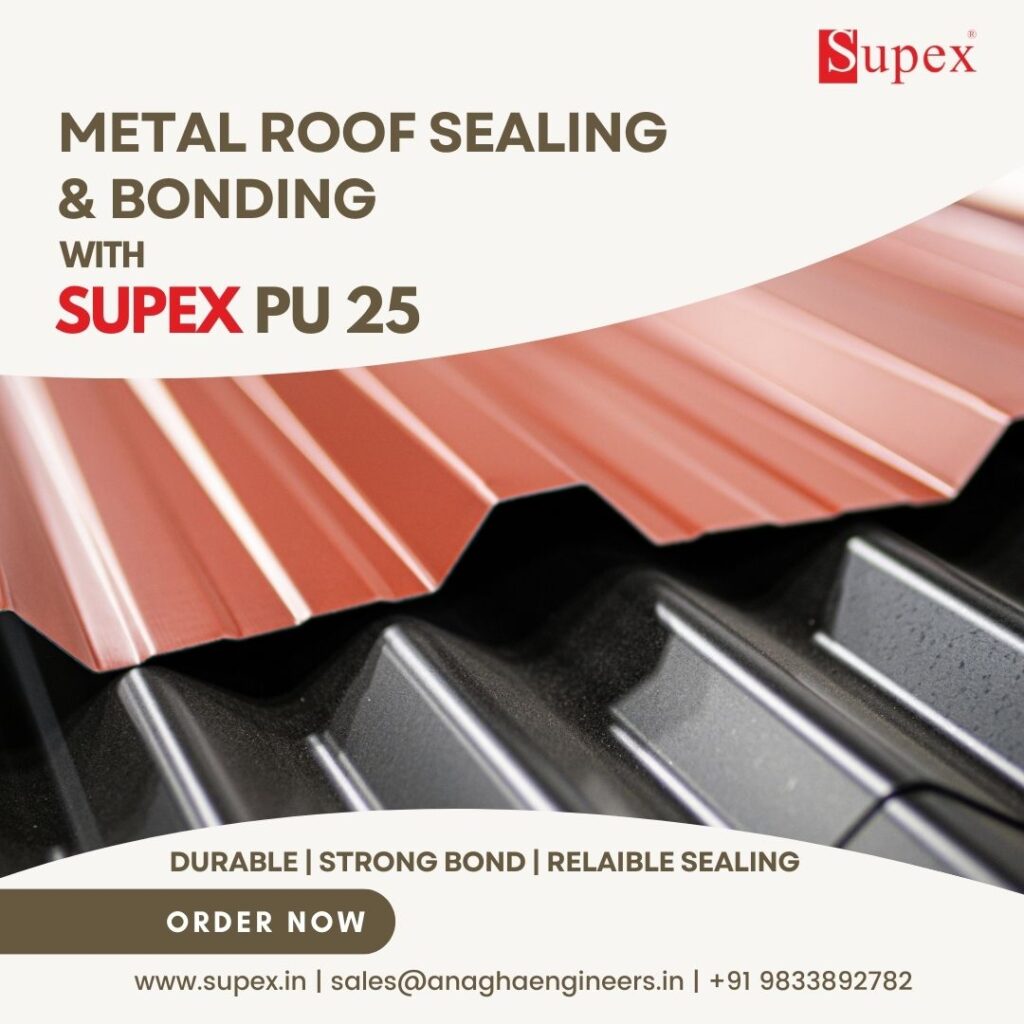
For industrial roof repairs, Supex PU 25 Polyurethane Sealant is a product worth considering for compatible metal joints and roof gaps.
Why Metal Roofs Develop Leaks
Metal roofs are durable but prone to leaks due to:
- Expansion and contraction causing gaps.
- Rust and corrosion.
- Loose or damaged screws.
- Seam and joint failures.
Supex metal roof sealant provide an additional waterproof layer, extends the lifespan, and ensures energy efficiency.
- Have you noticed leaks or signs of water damage on your roof? Is your energy bill rising unexpectedly?
- A small roof issue can spiral into a costly nightmare—damaging your home’s structure, encouraging mold growth, and draining your wallet.
- Seal your roof today with durable polyurethane sealants that protect against leaks and weather damage. Our professionals guarantee a watertight solution that lasts for years.”

Identify Water Leaks -Industrial roof waterproofing
Metal roof leaks challenge warehouse maintenance teams. Warehouses store goods and support logistics, so leaks create big issues. They damage inventory, weaken structures, and raise energy costs. This guide helps you spot leaks early, understand why Supex sealants excel, and use SUPEX technology for fast, effective repairs.
Identifying Warehouse Leaks Early detection saves money and prevents major damage. Look for these clear signs:
- Water Stains — Check walls, ceilings, and floors for discoloration. These show water has entered.
- Musty Odor — Persistent damp smells often mean mold or mildew from hidden moisture.
- High Humidity — Track warehouse humidity levels. Excess moisture causes condensation and mold growth.
- Damaged Goods — Inspect inventory for warped boxes, dampness, or mold spots.
- Rising Energy Costs — Leaks force heating and cooling systems to work harder. As a result, bills climb.
Catch these signs quickly. Then, repair promptly with high-quality sealants like Supex. This approach protects your warehouse and contents while keeping costs low.
Which Is the Best Sealant for Metal Roof Sheets?
The best sealant depends on the type of leak, roof material, and exposure to sunlight, rain, and temperature changes.
For many metal roof joint repairs, a flexible PU or MS polymer sealant is a practical starting point. Neutral-cure silicone may suit certain exposed metal joints where weather and UV resistance are key.
Here is a quick comparison.
| Sealant type | Main benefits | Best suited for | Important consideration |
|---|---|---|---|
| Polyurethane (PU) | Strong adhesion, flexibility, and weather resistance | Roof seams, joints, fastener areas, and compatible gaps | Standard PU products generally require a clean, dry surface |
| MS polymer | Flexible, weather-resistant sealing and bonding | Metal joints and compatible mixed-material connections | Confirm suitability for the joint and roof coating |
| Neutral-cure silicone | Good weather and UV resistance; non-corrosive formulations are available | Exposed metal joints and compatible flashing details | Usually not paintable; check substrate compatibility |
| Bitumen-based sealant | Useful in certain roofing repair systems | Specific repairs where the product is approved | Compatibility, movement, and exposed service life vary |
| Butyl tape | Convenient for suitable overlaps and sheet joints | Compatible roofing details and selected installations | Surface preparation and exposure affect long-term performance |
Quick recommendation: Consider PU sealant for strong, flexible joint sealing. Consider MS polymer when weather resistance and bonding across different materials are important. Choose neutral-cure silicone when the application calls for a weather-resistant, non-corrosive silicone.
Always check the product data sheet before selecting a sealant for a specific roof.
Best Supex Products to Consider for Metal Roof Sealing
Different roof problems need different solutions. Use the recommendations below to narrow your choice.
1. Supex PU 25 — For Metal Roof Joints and Gaps
Best for: Compatible roof joints, sheet connections, flashing details, and construction gaps.
Supex PU 25 is a polyurethane sealant designed for flexible sealing and strong adhesion to suitable materials, including metal, concrete, and wood.
Key benefits include:
Flexible sealing that accommodates joint movement
Strong adhesion to compatible substrates
Resistance to moisture and outdoor weather
Application using a standard sealant gun
A paintable finish after curing, subject to the product instructions
This makes it a useful option to evaluate for industrial roof maintenance and metal sheet leak repairs.
View product: Supex PU 25 Polyurethane Sealant
2. Supex 600 MS Polymer — For Flexible, Weather-Exposed Joints
Best for: Compatible metal-to-metal and metal-to-other-material joints that need flexible bonding or sealing.
Supex 600 MS Polymer Adhesive offers strong bonding, flexibility, and resistance to outdoor weather and UV exposure.
Consider it when the repair involves different materials or a joint that experiences movement.
Its key features include:
Flexible bonding after curing
Weather and UV resistance
Adhesion to a range of materials, including metal
A non-corrosive, solvent-free formulation
Paintability after curing, subject to compatibility
View product: Supex 600 MS Polymer Adhesive
3. Supex Neutral Plus — For Compatible Exposed Metal Sealing
Best for: Suitable exposed metal, glazing, and construction joints where neutral-cure silicone is required.
Supex Neutral Plus is a neutral-cure silicone sealant designed for weather-resistant sealing on metals, glass, and other compatible surfaces.
Its non-corrosive curing system makes it worth considering for sensitive metal surfaces. However, silicone is not the first choice for every roofing joint, especially where paintability or a particular bonding strength is required.
View product: Supex Neutral Plus Silicone Sealant
Product selection note: These are options to evaluate, not interchangeable products. Confirm the roof substrate, coating, joint design, movement, and exposure conditions before choosing a sealant.
Common Metal Roof Leak Problems and the Right Solution
Finding the source of a leak is the first step toward a lasting repair. Water can travel along the underside of a sheet before dripping, so the visible leak may not be directly below the entry point.
Scenario 1: Water Leaks Around Roof Screws
Common cause: Loose fasteners, damaged washers, or gaps around screw holes.
What to do: Inspect the fastener and washer. Replace damaged components where necessary, then apply a compatible sealant around the repair area according to the roofing system’s instructions.
A flexible PU sealant such as Supex PU 25 may be suitable for compatible fastener details.
Do not rely on sealant to compensate for a loose or structurally damaged fixing.
Scenario 2: Water Enters Through Overlapping Sheets
Common cause: Failed overlap seals, loose fixings, or movement between sheets.
What to do: Clean and inspect the overlap. Apply a continuous bead of a compatible sealant along the specified joint, following the roof manufacturer’s instructions.
For a joint that moves with temperature changes, a flexible PU or MS polymer product may be appropriate.
See Supex 600 MS Polymer Adhesive for an option to assess for compatible metal joints.
Scenario 3: The Roof Leaks Where It Meets a Wall
Common cause: Failed flashing, gaps between the wall and sheet, or movement at the connection.
What to do: Check the flashing and the full joint. Repair or replace damaged flashing first. Then seal the joint with a product compatible with both the roof and wall materials.
For suitable construction joints, Supex PU 25 is worth considering.
Large gaps may need a backing material or a mechanical repair before sealant is applied.
Scenario 4: Water Enters Through Rusted Roof Sheets
Common cause: Corrosion, damaged protective coatings, or holes in the sheet.
What to do: Assess the extent of the damage. Remove loose rust where appropriate and repair the protective coating as required.
Sealant may help with a compatible joint or small defect, but it is not a substitute for replacing a perforated or badly corroded sheet.
If the metal has lost its strength, replace the damaged section.
Scenario 5: Leaks Return Every Monsoon
Common cause: Incomplete repairs, poor surface preparation, failed joints, or movement that the previous sealant could not handle.
What to do: Inspect the entire roof rather than sealing only the visible drip. Check screws, seams, flashing, gutters, and roof penetrations.
Remove failed sealant where practical and choose a product that suits the joint movement and weather exposure.
For a more detailed repair guide, read How to Stop Metal Roof Sheet Leakage.
Scenario 6: Water Leaks Around Pipes or Roof Vents
Common cause: Failed seals around penetrations, damaged collars, or movement between the pipe and roof sheet.
What to do: Inspect the penetration and its flashing or collar. Replace damaged components, then seal the compatible joint using the correct roofing detail.
A sealant alone may not be enough if the penetration has been installed incorrectly or the flashing has failed.
How to Apply Metal Roof Sealant
Correct application helps improve adhesion and reduce repeat leaks.
Step 1: Find the Leak
Inspect the roof for water entry around screws, overlaps, seams, flashing, and penetrations.
Look for rust, loose fasteners, cracked sealant, and gaps. If the leak source is unclear, arrange a professional inspection.
Step 2: Prepare the Surface
Remove dirt, dust, loose rust, grease, and failed sealant from the repair area.
The surface must meet the sealant manufacturer’s preparation requirements. For standard Supex PU 25 applications, the surface should be clean and dry.
Step 3: Check Compatibility
Confirm that the sealant suits the metal, protective coating, and adjoining material.
If required, test adhesion on a small area. Use primer only when the product instructions call for it.
Step 4: Apply a Continuous Bead
Load the cartridge into a compatible sealant gun. Cut the nozzle to suit the joint width.
Apply an even bead across the full repair area. Avoid gaps, thin spots, and trapped air.
Step 5: Smooth the Sealant
Tool the bead according to the product instructions to ensure proper contact with the joint surfaces.
Use the recommended tooling method and finish the bead within the stated working time.
Step 6: Allow It to Cure
Keep the repair undisturbed for the recommended period. Protect it from rain and other exposure until the sealant reaches the required level of cure.
Curing time depends on the product, bead size, temperature, and humidity. Check the current technical data sheet before returning the roof to service.
Roof safety: Metal roofs can be slippery, sharp, and fragile. Do not work on a wet roof or near unprotected edges. Use suitable fall protection and a qualified roofing professional when needed.
How to Choose a Metal Roof Sealant: A Buyer’s Checklist
Before purchasing a roof sealant, consider these five points.
1. Roof material
Is the roof made from galvanised iron, steel, aluminium, or coated metal? Check that the sealant is compatible with the substrate and its finish.
2. Type of repair
A screw hole, moving seam, flashing joint, and corroded sheet may need different repair methods.
3. Weather exposure
Consider direct sunlight, rain, temperature changes, and standing water. Choose a product rated for the conditions it will face.
4. Joint movement
Metal sheets expand and contract with temperature changes. A suitable flexible sealant can accommodate movement within its rated limits.
5. Total repair cost
Compare more than the cartridge price. Include surface preparation, labour, access equipment, curing time, and the cost of repeat repairs.
For warehouses and factories, a suitable product and correct application can help reduce maintenance interruptions and protect stored goods.
Why Choose Supex for Metal Roof Sealing?
Supex offers sealants and adhesives for construction and industrial applications. The right product depends on the substrate, joint design, and repair requirements.
When assessing a Supex solution, consider:
Application fit: Match the product to the actual leak location.
Material compatibility: Check adhesion to the roof and adjoining surfaces.
Weather resistance: Select a formulation suited to outdoor exposure.
Movement capability: Confirm that the product can accommodate expected joint movement.
Technical support: Request the current technical data sheet and application guidance where needed.
Start with the Supex construction adhesives and sealants range to review available options.
For industrial roof leaks, you can also explore Supex PU 25 or Supex 600 MS Polymer Adhesive based on your application.
How to Apply SUPEX PU 25 PU sealant
Follow these simple steps:
- Prepare the Surface Clean the area thoroughly. Make sure it stays dry and free of dust, dirt, or old sealant.
- Prime if Needed Check the surface and manufacturer guidelines. Apply primer when recommended to boost adhesion.
- Apply the Sealant Insert the cartridge into a caulking gun. Cut the nozzle at a 45-degree angle. Then, fill the joint or crack completely.
- Tool the Sealant Smooth it neatly with a putty knife. Avoid over-tooling to keep the seal effective.
- Let It Cure Allow full curing per instructions—usually 24–48 hours, depending on weather.
Use SUPEX PU 25 metal roof sealant for fast, durable fixes that stop leaks for good.
Benefits of Using Supex Roof Sealants
- Prevents water leakage
- Protects against corrosion
- Improves energy efficiency
- Extends roof lifespan
- Reduces maintenance cost
- Provides flexible joint sealing
Supex PU Sealant vs Silicone Sealant vs Bitumen
| Feature | Metal Roof PU Sealant | Silicone Sealant | Bitumen Sealant |
|---|---|---|---|
| Flexibility | High | Medium | Low |
| Waterproofing | Excellent | Good | Good |
| UV Resistance | High | High | Medium |
| Durability | Long-lasting | Medium | Medium |
| Adhesion to Metal | Excellent | Good | Low |
Frequently Asked Questions
1. What is the best sealant for a metal roof?
The best sealant depends on the roof material and leak location. PU sealants are useful for many compatible joints, while MS polymer and neutral-cure silicone products may suit other applications. Check the product data sheet before use.
2. Which Supex product is suitable for metal roof leaks?
Supex PU 25 is an option for compatible roof joints and gaps. Supex 600 MS Polymer may suit certain flexible, weather-exposed joints. The correct choice depends on the substrate, joint design, and service conditions.
3. Can I use silicone sealant on a metal roof?
Yes, some silicone sealants are suitable for specific metal roof joints. Choose a compatible formulation, such as neutral-cure silicone when required, and confirm its suitability for the roof coating and joint design.
4. Can roof sealant stop leaks around screws?
A compatible sealant can help seal gaps around fasteners. However, damaged washers, loose screws, and enlarged holes may need repair or replacement before sealing.
5. Can I apply roof sealant during the monsoon?
Do not assume every sealant can be applied in wet conditions. Standard PU sealants such as Supex PU 25 require a clean, dry surface. Follow the current product instructions and avoid application during active rain.
6. How long does metal roof sealant last?
Service life depends on the formulation, joint movement, UV exposure, surface preparation, and maintenance. Inspect repaired areas regularly and follow the manufacturer’s recommendations rather than relying on one lifespan estimate.
7. Can I apply new sealant over old sealant?
This depends on the product and condition of the existing material. Failed, loose, or contaminated sealant should generally be removed. Follow the manufacturer’s instructions for surface preparation and compatibility.
8. Will sealant repair a rusted or perforated metal sheet?
Sealant may help seal certain joints, but it cannot restore metal that has lost its structural strength. A perforated or badly corroded sheet may need replacement.
9. What is the difference between PU and MS polymer roof sealant?
PU sealants offer strong adhesion and flexible sealing for many construction joints. MS polymer products also provide flexible bonding and weather resistance and may offer advantages for certain mixed-material applications. Compare the technical specifications for your particular repair.
10. Where can I buy a suitable metal roof sealant?
You can review the Supex PU 25 product page and the Supex construction sealant range. Contact Supex for help selecting a product for your roof material and leak type.
Stop Metal Roof Leaks with the Right Sealant
A lasting roof repair starts with finding the real source of the leak. Check screws, sheet overlaps, flashing, roof-to-wall joints, and penetrations before choosing a sealant.
For compatible metal roof joints, Supex PU 25 is one option to evaluate. For other flexible, weather-exposed joints, Supex 600 MS Polymer may be worth considering.
Choose a product that suits the material, prepare the surface correctly, and follow the application and curing instructions.
Need help choosing a sealant for your roof? Visit the Supex construction sealants range or contact the Supex team for product guidance.
2 Responses
PU sealent
Very useful post! Choosing the right metal roof sealant is essential for preventing leaks, extending roof lifespan, and maintaining effective waterproofing. While sealants can provide an excellent repair solution, proper surface preparation and timely maintenance are just as important for achieving long-lasting results. This guide offers valuable information for homeowners and property managers looking to protect their roofing investment.