
Metal glue is a high-strength industrial adhesive designed for permanent metal-to-metal bonding without welding or mechanical fasteners. Modern metal bonding adhesives are widely used in OEM manufacturing, fabrication, automotive assembly, and industrial equipment production.
Industrial metal glue provides excellent load-bearing strength, vibration resistance, and corrosion protection, making it an ideal alternative to welding, riveting, and brazing. In India’s growing manufacturing sector, metal bonding adhesives help improve productivity, reduce distortion, and enhance product durability.
What is Metal Glue?
Metal glue is a structural adhesive specifically formulated to bond metal surfaces such as steel, aluminum, stainless steel, and galvanized metals. Unlike traditional joining methods like welding or bolting, metal bonding adhesives create uniform stress distribution across the bonded surface.
Industrial metal glue provides strong adhesion, chemical resistance, and long-term durability even under demanding environmental conditions. These adhesives are commonly used in OEM manufacturing, heavy equipment assembly, transportation, and construction industries.
Why Use Metal Glue Instead of Welding?
Metal glue offers several advantages over traditional welding and mechanical fastening methods. It eliminates heat distortion, reduces assembly time, and improves fatigue resistance.
Key Advantages:
• No heat damage to metal surfaces
• Uniform load distribution
• Reduced corrosion risk
• Faster production cycles
• Lightweight assembly design
• Ability to bond dissimilar metals
• Improved vibration resistance
Industrial manufacturers in India increasingly use metal bonding adhesives as an alternative to welding for structural applications.
Types of Industrial Metal Glue
Epoxy Metal Glue
Epoxy-based metal glue provides high shear strength and excellent resistance to chemicals and temperature. It is commonly used for structural metal bonding in machinery, tooling, and repair applications. Eg: Supex ECL30- clear 2 part bonding epoxy
MMA Metal Bonding Adhesives
Methyl Methacrylate (MMA) metal glue offers exceptional impact resistance and fast curing performance. MMA adhesives are widely used in OEM manufacturing where high-strength bonding and production efficiency are required.
Supex M419, Supex GP 0416, Supex 3090
Polyurethane Metal Adhesives
Polyurethane-based metal glue provides flexibility and shock resistance, making it suitable for applications exposed to vibration and movement.
Supex 8104, Supex 7150
MS Polymers
Single part adhesive for bonding and sealing. Fast bonding, moisture cure, paintable.
Supex Bond All HIgh Tack Adhesive, Supex 600, Supex 620
Applications of Industrial Metal Glue
OEM Manufacturing
Metal glue is widely used in OEM production lines for bonding metal enclosures, panels, frames, and structural components.
Automotive & Transportation
Industrial metal bonding adhesives are used in vehicle body assembly, metal panel bonding, and vibration-resistant joints.
Industrial Equipment Assembly
Heavy-duty metal glue is commonly used in machine manufacturing, metal fabrication, and industrial maintenance applications.
Construction & Infrastructure
Metal bonding adhesives provide durable connections in structural components used in infrastructure and building systems.
Metals That Can Be Bonded Using Metal Glue
Industrial metal glue can bond a wide range of metals including:
• Steel
• Stainless Steel
• Aluminum
• Galvanized Metal
• Brass
• Copper
• Cast Iron
These adhesives also support bonding of dissimilar metals without galvanic corrosion issues.
Metal Glue vs Welding vs Mechanical Fasteners
| Feature | Metal Glue | Welding | Fasteners |
|---|---|---|---|
| Heat Required | No | Yes | No |
| Surface Damage | No | Possible | Yes |
| Vibration Resistance | Excellent | Moderate | Moderate |
| Corrosion Resistance | High | Medium | Medium |
| Production Speed | Fast | Slow | Medium |
| Design Flexibility | High | Low | Medium |
How to Choose the Right Industrial Metal Glue
Selecting the correct metal glue depends on several factors:
• Type of metal substrate
• Load requirements
• Environmental exposure
• Temperature resistance
• Production cycle time
• Gap filling capability
Industrial buyers should evaluate performance specifications such as shear strength, curing time, and environmental resistance before selecting a metal bonding adhesive.
Frequently Asked Questions
What is the strongest metal glue for industrial use?
Structural adhesives such as epoxy and MMA-based metal bonding adhesives provide the highest strength for industrial and OEM applications.
Can metal glue replace welding?
Yes. In many industrial applications, metal glue can replace welding by providing strong bonds without heat distortion or metal fatigue.
Does Supex glue work on stainless steel?
Yes. Most industrial metal bonding adhesives are specifically designed to bond stainless steel and other difficult metals.
How long does glue take to cure?
Curing time depends on adhesive type and environmental conditions, ranging from minutes to several hours.

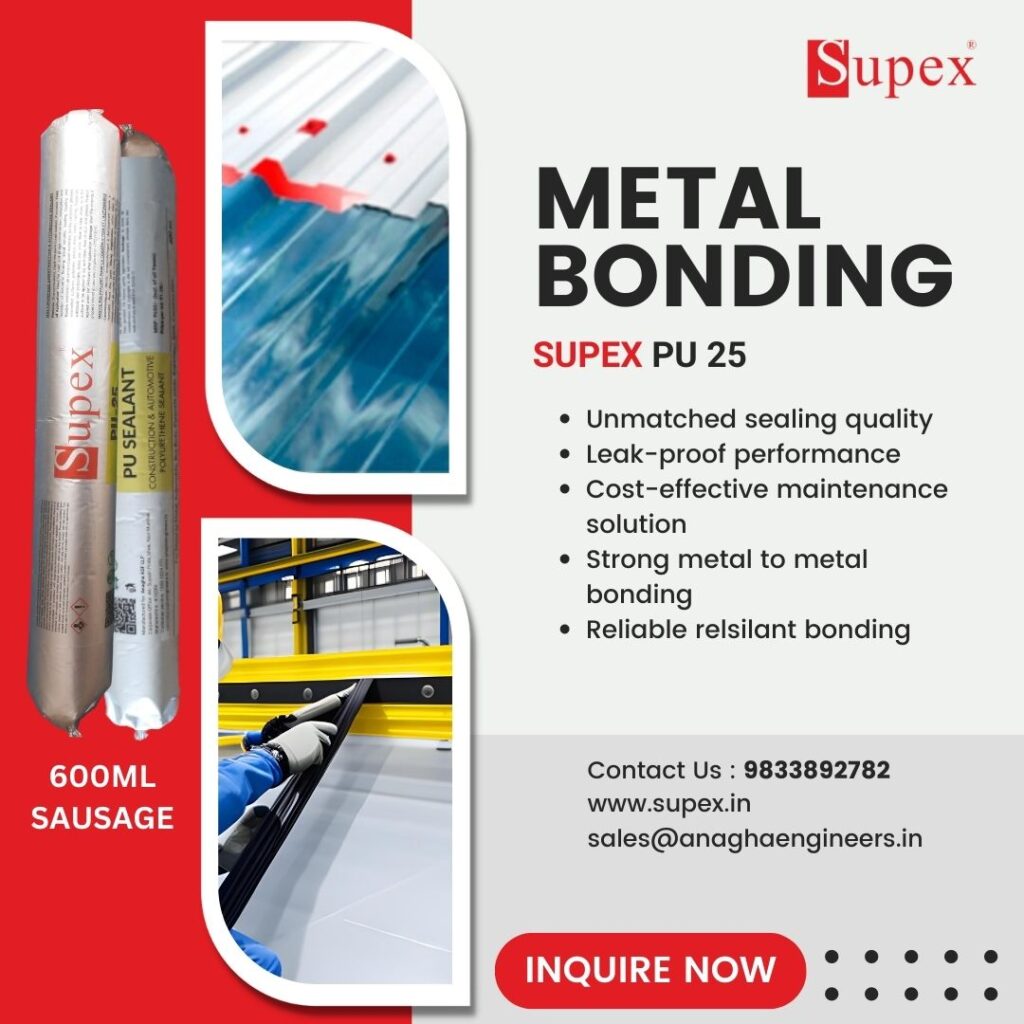

Applications of Metal adhesives:
Automotive Repairs:
- Repair cracked metal parts, exhaust systems, or bodywork without the need for welding.
Home and Construction Projects:
- Bond metal fixtures, fittings, and hardware in home improvement and construction tasks.
DIY and Craft Projects:
- Perfect for small metal-based projects, such as jewelry-making, metal art, or crafting.
Industrial and Manufacturing:
- Used in machinery repair, electronics, and appliance assembly where a high-strength, precise bond is required.
Bond metal with confidence—try our strong and durable metal glue today
Call / Whatsapp- +91 9699892782 for metal to metal adhesives
Surface Preparation for the Metal Adhesive Bonding Process
Choosing the right metal joining adhesive can be challenging. Different metals react differently to heat, moisture, and load. Therefore, environmental conditions matter. As a result, no single adhesive works best for every metal application. Instead, designers must select an adhesive based on performance needs and design requirements.
Most metals have high surface energy. This helps adhesives spread and bond well. Consequently, bond strength improves. However, painted and powder-coated metals behave differently and need special treatment.
On painted metal, the adhesive bonds to the paint layer, not the metal. Still, strong bonding is possible. First, you can mask bonding areas before painting to keep bare metal exposed. Alternatively, you can select an adhesive designed to bond directly to painted surfaces. The choice depends on the required bond strength.
Powder coating creates additional challenges. Manufacturers apply powder coat as an electrostatic resin and cure it with heat. Because these coatings often have low surface energy, adhesives struggle to wet them. Therefore, adhesive selection becomes critical.
Clean surfaces ensure strong bonds. Always remove dust, oil, moisture, and handling residue. Even fingerprints can weaken adhesion.
Surface texture also affects bonding. Light abrasion increases surface area and removes contaminants. As a result, mechanical strength improves. However, this benefit depends on adhesive flow. Bonding tapes cannot penetrate deep scratches. In contrast, liquid adhesives flow easily and fully wet rough surfaces.
Metal joining adhesive in India: Choosing the Right Process
Finally, consider how bonding fits into your assembly process. Decide whether it matches your workflow or requires changes. Also evaluate end use, durability, and cost. Together, these factors guide the right adhesive choice.
For more expert insights from Supex, sign up and stay connected.
8 Responses
Sir,
We are looking for nbr to metal bounding adhesive.
Request your contact details to discuss further. You could call me at 9833892782
Metal bonding paste, Request to mention Peel off strength & cure time.
Sir- Technical data sheet of the product emailed
Sir
I am sr manager engg in a fine chemical company. Can you please suggest me such products which can be used for leakage stoping of MS, SS lines of half inch to 24 ” inch sige lines having hot liquid of chemical properties af alkline and acidic both types and pressure up to 4 kg cmsq
For such applications, you can try”Pipe repair kit” – consists of 2part metal filled putty and urethane tape. Process is:
1. Depressurize the system
2. clean the leakage area, Roughten with emery paper or file.
3. Knead and apply putty on the leaking hole
4. Wet the urethane tape and wrap it like a bandage around the leaking area.
Need to bond sheet metal to sheet metal glue , with minimum curing time., suitable for mass productions.
please suggest.
Sir- You can use Supex 488 or Supex HP 603UV – these are MS polymer adhesives with clear advantages:
1. Bonds most surfaces including metal, sheet metal, concrete, wood etc
2. Quick curing ( drying)
3. High strength
4. Weather resistant
5. Paintable
6. Environment & user friendly ( Zero VOC, no smell )
Request your contact details to reach you.