
Why metal joining adhesive ?
Using metal joining adhesive offers many benefits for bonding metals. It serves as an essential tool. You can repair, assemble, or craft easily. This adhesive creates strong, durable bonds. You avoid welding or rivets.
Here are key reasons to choose metal joining adhesive:
- Strong and Durable Bonds Epoxy or acrylic-based glues deliver high strength. They handle heavy stress. You rely on them for structural and industrial tasks.
- No Specialized Equipment Needed You apply metal glue with ease. It needs few tools. In contrast, welding demands skills and costly gear. This option fits DIY projects, home fixes, and small production.
- Versatile Uses Metal glue bonds various surfaces. It works on steel, aluminum, copper, and metal-to-plastic. You use it in automotive repairs, construction, appliances, arts, and crafts.
- Flexibility and Impact Resistance Many glues remain flexible after curing. They resist cracks from vibration or pressure. Additionally, they adapt to temperature changes as metals expand or contract.
- Time and Cost Savings Metal adhesive sets fast. It cuts downtime. You also save money on small or quick jobs.
- Clean, Professional Look Glue forms invisible bonds. You skip visible fasteners. This creates sleek results for furniture, decor, or auto bodywork.
- Environmental Resistance Top adhesives fight moisture, heat shifts, chemicals, and UV rays. Therefore, you apply them indoors or outdoors.
- Gap-Filling Power Certain glues fill spaces. They ensure smooth bonds despite minor gaps or misalignments.
- Low Maintenance Once cured, glue requires almost no care. Bonds last long. Unlike bolts, they rarely loosen.
- Simple Application You spread most glues quickly. Choose syringes, brushes, or applicators. Many cure rapidly, and heat speeds the process.
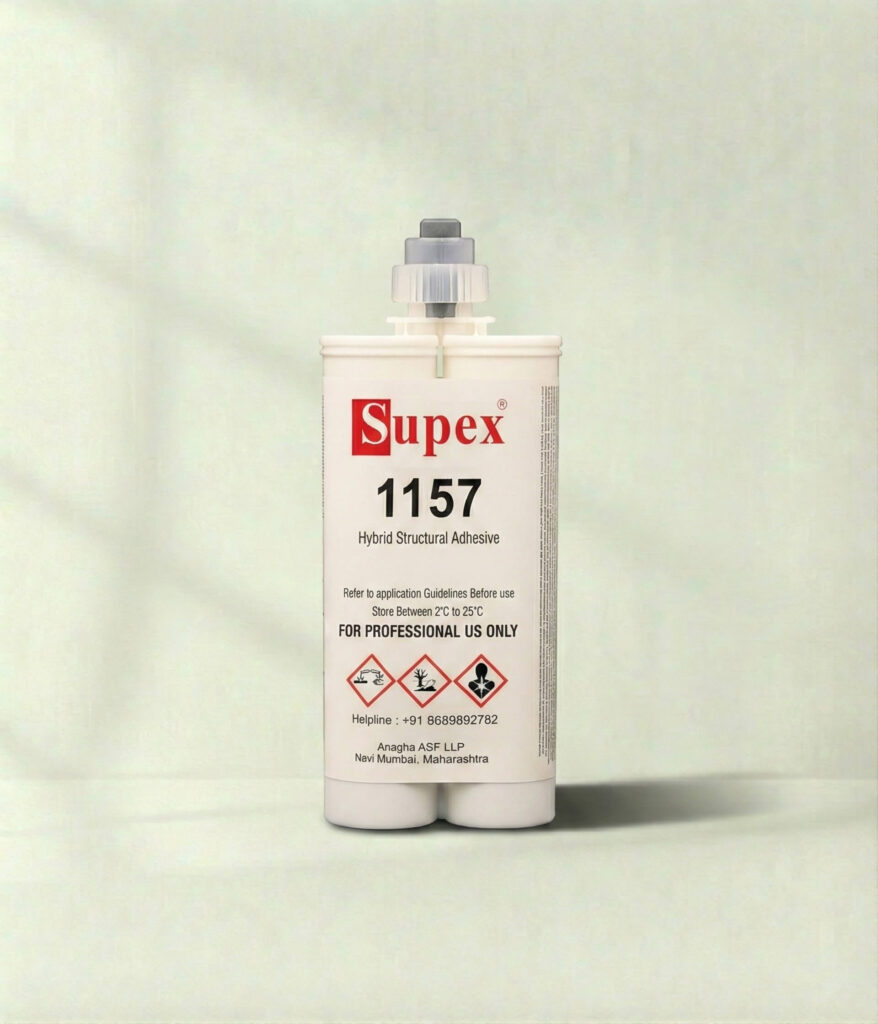

Applications of Metal adhesives:
Automotive Repairs:
- Repair cracked metal parts, exhaust systems, or bodywork without the need for welding.
Home and Construction Projects:
- Bond metal fixtures, fittings, and hardware in home improvement and construction tasks.
DIY and Craft Projects:
- Perfect for small metal-based projects, such as jewelry-making, metal art, or crafting.
Industrial and Manufacturing:
- Used in machinery repair, electronics, and appliance assembly where a high-strength, precise bond is required.
Bond metal with confidence—try our strong and durable metal glue today
Metal-joining Adhesive vs. Welding
Welding is a common method for metal-to-metal assembly. In many ways, metal joining adhesive offer a similar result. For example, both methods create smooth joints. Neither leaves protruding fastener heads. As a result, finished parts look clean and streamlined.
However, welding also brings several disadvantages. These issues do not apply to metal-to-metal adhesive bonding. Moreover, welding introduces complications that often remain hidden at first.
First, welding causes thermal distortion. Every weld pulls the metal. This movement can distort the final product and may even cause cracking. Next, welding demands skilled labor. While anyone can bolt metal parts together, welding requires trained welders or expensive automation.
In addition, welding involves many variables. These variables change with material and joint type. Welding mild steel may seem simple. However, welding high-alloy steel or other metals requires expert knowledge. Factors include voltage, current, wire feed speed, travel speed, and heat input. They also include filler metal selection, preheat and post-heat control, process choice, shielding gas or flux, hydrogen control, and mechanical adjustments like grinding or peening.
Furthermore, welding struggles with dissimilar metals. It limits design flexibility. Many welding defects also remain invisible. Therefore, manufacturers rely on testing methods such as liquid penetrant, magnetic particle, ultrasound, and radiography. Each method requires skilled labor and adds cost.
In contrast, metal-bonding adhesives simplify the process. Most adhesives need minimal training. Consequently, they deliver consistent quality and lower production costs.
Discover modern adhesive solutions for metal bonding in India. Sign up to learn how adhesives can replace costly welding methods.
Metal glue vs Fasteners
Fasteners such as bolts and screws are very common methods of bonding for temporary joints. Fasteners are also suitable for semi temporary joints such as those in automotive assemblies. Nevertheless, problems may occur as fasteners require carefully placed holes, are prone to corrosion and may loosen over time.
This is where metal glue come into picture: removable adhesives and tapes are suitable for temporary bonding, and they do not leave traces behind after removal. Adhesives are also suitable for semi temporary joints as they seal from corrosion, are generally lighter and cheaper than mechanical fasteners, and distribute the stress throughout the bond making the assembly stronger. Some metal bonding adhesives come with special properties such as chemical resistance and heat resistance. Heat resistant glue for metal is common in public transport vehicles, automotive industry and general industrial applications. Metal glue can also be used for supporting fasteners: threadlocking and thread sealing are common applications where a metal glue makes sure the fastener does not loosen over time.
If your design uses fasteners, click here to receive more information about other adhesive options.
Call / Whatsapp- +91 9699892782 for metal to metal adhesives
Types of metal bonding adhesive
- Epoxy adhesive is one of the strongest metal glue. It exists in different types which have unique properties such as chemical resistance and heat resistance. Epoxies come as one or two component systems. Single component epoxy glue for metal cures as a result of additional heat. A 2K system is a mixture of two parts with react with each other starting the curing process. When looking for the strongest glue for metal, a 2K epoxy for metal should be considered.
Limitations of epoxy adhesiives:
- 2 part mixing is messy, time-consuming, not suitable for continuous production.
- Epoxy is brittle by nature, can’t take vibrations or flexing
- labour intensive, application cannot be automated
- 2 part cartridge requires special gun applicator and still not user friendly.
- it has a typical smell
2. Acrylic adhesive metal glue exists as two types: surface activated and and bead on bead acrylics. The latter refers to applying a bead of adhesive on  both substrates before connecting them. The bonding starts when the parts come in contact with each other and become subject to pressure. Surface activated acrylics, in turn, require a water thin initiator applied to one substrate and the resin to the other.
Limitations:
- 2part system- time consuming, not friendly for high speed production lines.
- limited flexibility, joints cannot be subjected to flexing
- adhesive cost is high
3. Cyanoacrylate, also known as instant adhesive, is a versatile metal glue. Cyanoacrylate adhesives is suitable for most metals as long as they are reactive.
Limitations:
- brittle bondline after curing, cannot be subjected to joint movement and flexing
- debonds or bond fails if in contact with water continuously
- health hazard- bonds to skin instantly, while curing it emits vapours with a strong smell, eye irritant
- not suitable for large bonding areas, cannot fill high gaps ( > 1 mm)
4. Anaerobic metal adhesives are only used for glueing metal to metal as they require the presence of metal and absence of oxygen to be able to cure. Anaerobic adhesives are ideal for securing fasteners in terms of thread-locking and thread sealing as well as gasketing and retaining.
Limitations:
- cannot be used for high gap fill applications eg: sheet metal bonding
- cured adhesive is not flexible so cannot withstand flexing and joint movement.
- Suitable only for specific engineering application only. Not suitable for typical large surface area bonding
- Doesn’t work with non-metal substrates
5. Polyurethane sealant and adhesive : PU sealants are excellent for bonding / sealing metal to metal joints. In fact, in India, it is a popular adhesive used as a bodysealant for busbody manufacturing. It has high elongation, flexibility, bonds well on metals, paintable and at affordable cost too.
Limitations:
- Need to protect from UV light.
- contains solvents, not VOC free.
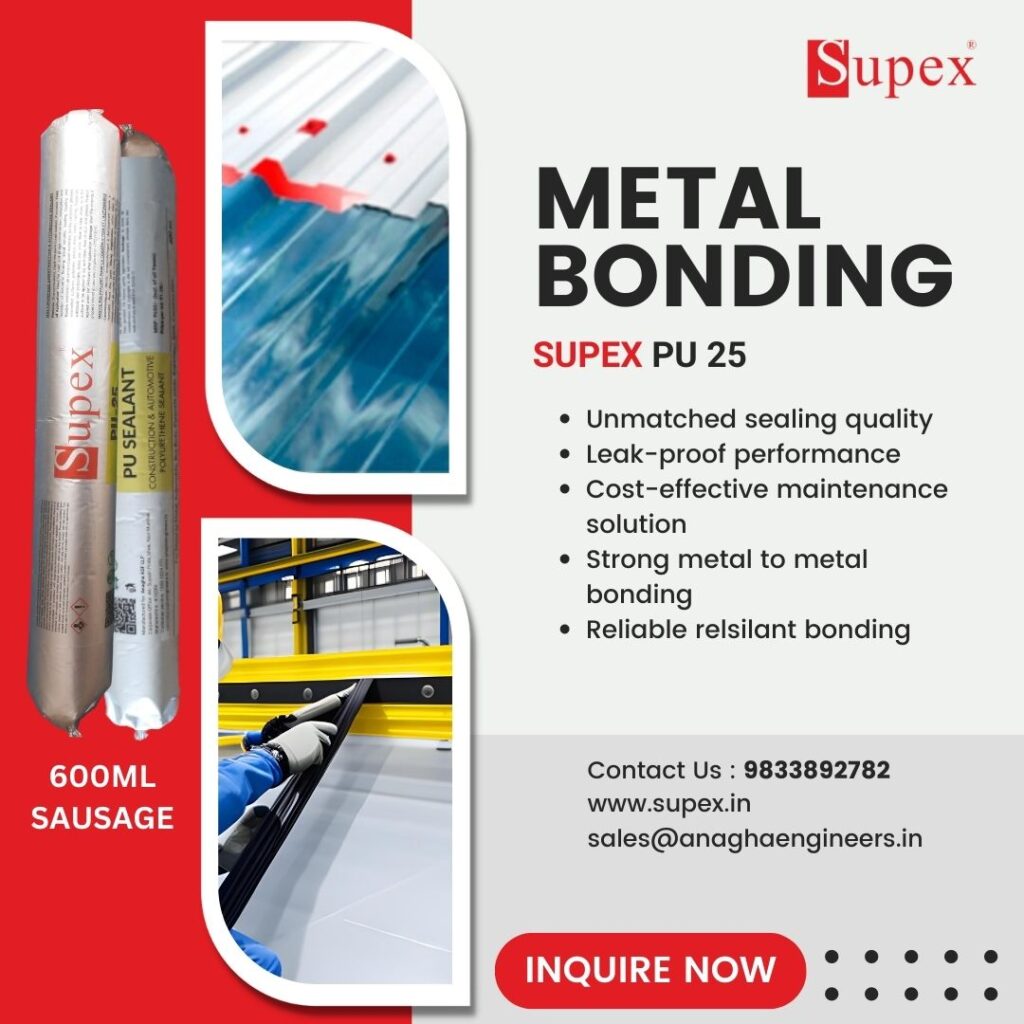
Supex PU 25: Moisture cure sealant suitable for metal bonding.
- Hardness (ASTM D 53505): 40±5 Shore A
- Elongation at Break(DIN 53504): ≥ 500%
- Modulus 100 % (DIN 53504): > 0,4 Mpa
- Tensile Strength: 10 N/mm2
6. MS polymer adhesive : This chemistry was developed to combine the weathering/  environment resistance of Silicones and high gap fill, flexibility, paintability of Polyurethanes. Also it is solvent and Isocyanate free, high strength with high elongation, paintable, UV resistant. It is a verstile bonder and bonds to most building material and engineering substrates except telfon, PP, HDPE, LDPE. This technology is already a dominant player in Japan, gathering pace in USA, Europe. It is widely used for automotive, Industrial and construction applications.
Limitations:
- Product cost is higher than Silicone or polyurethane sealants.
- Temperature resistance, works up to 100 C. is lower than RTV Silicones.
Supex Bond All HT – One part, moisture cure, modified silane, flexible, high bond strength, UV resistant, VOC free weather resistant, works underwater, high tack, verstile adhesive.
Surface Preparation for the Metal Adhesive Bonding Process
Choosing the right metal joining adhesive can be challenging. Different metals react differently to heat, moisture, and load. Therefore, environmental conditions matter. As a result, no single adhesive works best for every metal application. Instead, designers must select an adhesive based on performance needs and design requirements.
Most metals have high surface energy. This helps adhesives spread and bond well. Consequently, bond strength improves. However, painted and powder-coated metals behave differently and need special treatment.
On painted metal, the adhesive bonds to the paint layer, not the metal. Still, strong bonding is possible. First, you can mask bonding areas before painting to keep bare metal exposed. Alternatively, you can select an adhesive designed to bond directly to painted surfaces. The choice depends on the required bond strength.
Powder coating creates additional challenges. Manufacturers apply powder coat as an electrostatic resin and cure it with heat. Because these coatings often have low surface energy, adhesives struggle to wet them. Therefore, adhesive selection becomes critical.
Clean surfaces ensure strong bonds. Always remove dust, oil, moisture, and handling residue. Even fingerprints can weaken adhesion.
Surface texture also affects bonding. Light abrasion increases surface area and removes contaminants. As a result, mechanical strength improves. However, this benefit depends on adhesive flow. Bonding tapes cannot penetrate deep scratches. In contrast, liquid adhesives flow easily and fully wet rough surfaces.
Metal joining adhesive in India: Choosing the Right Process
Finally, consider how bonding fits into your assembly process. Decide whether it matches your workflow or requires changes. Also evaluate end use, durability, and cost. Together, these factors guide the right adhesive choice.
For more expert insights from Supex, sign up and stay connected.
8 Responses
Sir,
We are looking for nbr to metal bounding adhesive.
Request your contact details to discuss further. You could call me at 9833892782
Metal bonding paste, Request to mention Peel off strength & cure time.
Sir- Technical data sheet of the product emailed
Sir
I am sr manager engg in a fine chemical company. Can you please suggest me such products which can be used for leakage stoping of MS, SS lines of half inch to 24 ” inch sige lines having hot liquid of chemical properties af alkline and acidic both types and pressure up to 4 kg cmsq
For such applications, you can try”Pipe repair kit” – consists of 2part metal filled putty and urethane tape. Process is:
1. Depressurize the system
2. clean the leakage area, Roughten with emery paper or file.
3. Knead and apply putty on the leaking hole
4. Wet the urethane tape and wrap it like a bandage around the leaking area.
Need to bond sheet metal to sheet metal glue , with minimum curing time., suitable for mass productions.
please suggest.
Sir- You can use Supex 488 or Supex HP 603UV – these are MS polymer adhesives with clear advantages:
1. Bonds most surfaces including metal, sheet metal, concrete, wood etc
2. Quick curing ( drying)
3. High strength
4. Weather resistant
5. Paintable
6. Environment & user friendly ( Zero VOC, no smell )
Request your contact details to reach you.