
Gasket Sealant: Uses, Types, Application Steps & How to Choose the Right One
A leaking engine, gearbox, or industrial machine can lead to costly repairs and unexpected downtime. In many cases, the problem starts with a poor seal between two surfaces.
Gasket sealant helps prevent these leaks by filling small gaps and surface imperfections. It creates a reliable barrier against fluids and gases when used with compatible materials and the correct application method.
But not every sealant works for every job. Some are designed for high temperatures, while others work best on flat, machined metal surfaces.
In this guide, you will learn what gasket sealant is, where to use it, which types are available, and how to apply it correctly.
What Is Gasket Sealant?
Gasket sealant is a sealing compound used to prevent fluids or gases from escaping through joints between two surfaces. It fills small gaps, scratches, and irregularities that may cause leaks.
Some gasket sealants work with traditional gaskets. Others form a gasket directly between two surfaces after application and curing.
Liquid gasket sealants are widely used in automotive, manufacturing, and industrial maintenance because they can simplify assembly and help create a close-fitting seal.
Why Traditional Gaskets Leak
- Even best-machined
 flanges have tiny irregularities that solid gaskets can’t fully seal—worse on cast or sheet metal parts.
 - Gaskets lose compression over time (compression set).
- Pressure and vibrations push them out.
- Hard to find exact replacement sizes during repairs.
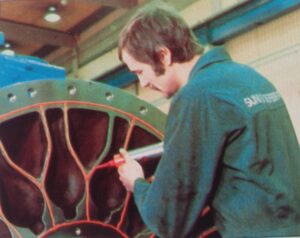 flanges have tiny irregularities that solid gaskets can’t fully seal—worse on cast or sheet metal parts.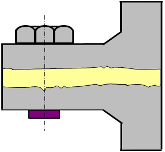

Leak free flanges with Supex flange sealants
Mobile/ Whatsapp: +91 9699892782, email: [email protected]
Key Benefits of Liquid Gasket Sealants
Liquid gasket sealants offer reliable sealing performance across a wide range of industrial and automotive applications. Unlike traditional gaskets, Supex flange sealants create a custom-fit seal that prevents leaks and improves equipment durability.
1. Leak-Proof Sealing Performance
Supex flange sealants form a continuous, airtight seal that prevents leakage of oil, coolant, water, and gases. This ensures consistent performance in engines, pipelines, and industrial machinery.
2. Fills Surface Irregularities
Unlike solid gaskets, liquid gasket sealants adapt to uneven surfaces and fill small gaps, scratches, and imperfections. This improves sealing efficiency and reduces the risk of failure.
3. High Temperature Resistance
Supex metal flange sealants are designed to withstand extreme temperatures, making them suitable for high-heat environments such as engines, exhaust systems, and industrial equipment.
4. Resistant to Chemicals and Fluids
Supex flange sealants provide excellent resistance to oils, fuels, coolants, and industrial chemicals, ensuring long-lasting performance even in harsh operating conditions.
5. Reduces Maintenance and Downtime
By creating a durable and reliable seal, liquid gasket sealants help reduce maintenance frequency, prevent leaks, and minimize costly downtime.
6. Easy Application and Fast Curing
Liquid gasket sealants are easy to apply directly to flanges and joints. Many formulations offer quick curing times, allowing faster assembly and reduced production delays.
7. Replaces Traditional Gaskets
Supex metal flange sealants can eliminate the need for pre-cut gaskets, reducing inventory requirements and simplifying installation processes.
8. Long-Lasting Durability
High-performance liquid gasket sealants maintain sealing strength over extended periods, even under vibration, pressure, and thermal cycling.
What Is Gasket Sealant Used For?
Gasket sealant is useful wherever two joined surfaces need a reliable seal. The right product depends on the materials, temperature, pressure, and type of fluid involved.
1. Automotive Engines
Engines contain several joints that must prevent oil and coolant leaks. A suitable gasket sealant can help seal compatible engine components.
Examples of use:
Sealing oil pans and sump joints
Sealing valve covers
Sealing water pump housings
Sealing timing covers and other compatible engine housings
For example, a mechanic replacing an oil pan may use an automotive-grade RTV silicone sealant if the manufacturer specifies a formed-in-place gasket.
2. Gearboxes and Transmissions
Gearboxes rely on tight seals to retain lubricating oil and protect internal components.
An anaerobic flange sealant can be suitable for rigid, closely fitted metal housings, provided the product matches the joint design.
Example: During gearbox maintenance, a technician applies flange sealant to a clean, machined housing before reassembling it.
3. Industrial Pumps and Compressors
Pumps and compressors may experience vibration, temperature changes, and pressure fluctuations.
A suitable gasket sealant helps prevent leakage at compatible flange joints and supports reliable equipment operation.
Example: A maintenance team uses an approved flange sealant when reassembling a metal pump housing to reduce the risk of oil or fluid leakage.
4. Industrial Machinery and Equipment
Industrial equipment often contains metal covers, housings, and flanged connections that require dependable sealing.
Gasket sealants can help reduce leakage, simplify assembly, and limit maintenance downtime.
Examples include:
Machine housings
Transformer enclosures, where the sealant is approved for the application
Industrial gear drives
Process equipment and compatible pipe flanges
Always check the product’s chemical compatibility and operating limits before use.
Types of Gasket Sealant
Choosing the right gasket sealant is essential for a durable seal. The main types differ in how they cure, how much movement they tolerate, and the applications they suit.
1. RTV Silicone Gasket Sealant
RTV stands for room-temperature vulcanising. This type of silicone sealant cures when exposed to moisture in the air, forming a flexible rubber-like seal.
Best suited for:
Compatible engine covers and oil pans
Sheet-metal covers
Joints with minor surface irregularities
Applications that require flexibility and heat resistance
RTV silicone is useful when the joint needs a flexible seal. However, not every RTV grade is suitable for fuels, high pressures, or every type of oil.
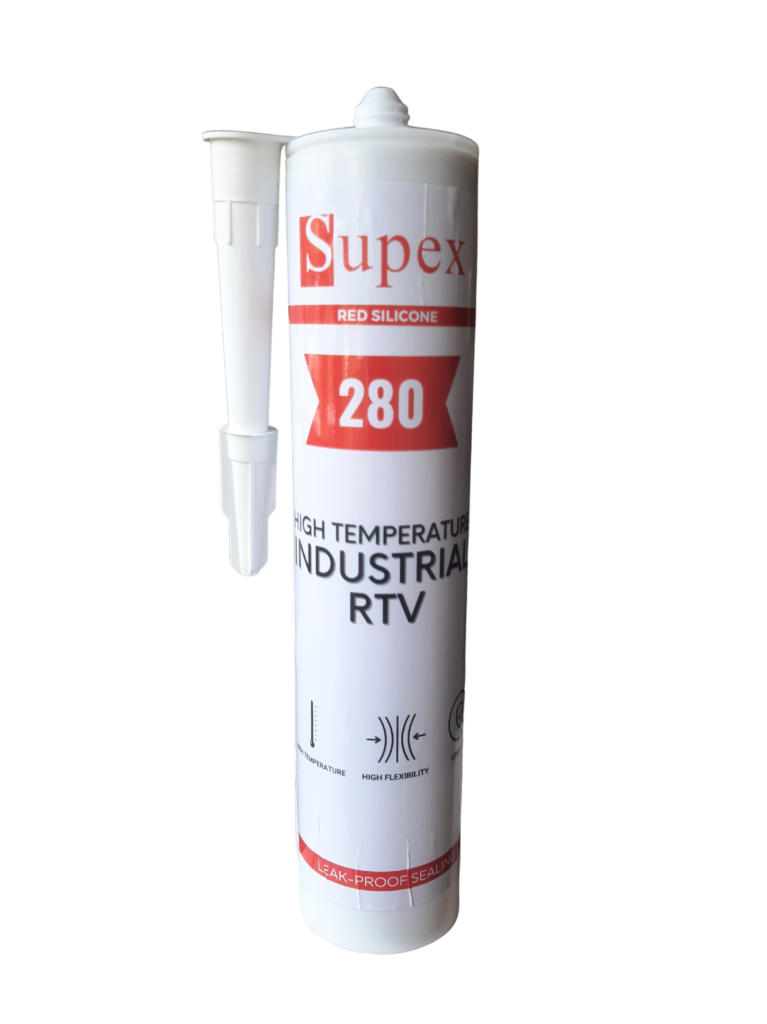
Recommended product: Supex 280 High Temperature RTV Silicone Sealant
This product is designed for high-temperature sealing applications and is rated for temperatures up to 300°C. Check the technical data sheet for the conditions and materials it supports.
2. Anaerobic Gasket Sealant
Anaerobic gasket sealants cure when confined between closely fitted metal surfaces with limited exposure to air.
They are commonly used on rigid, machined metal flanges where the gap is small.
Best suited for:
Gearbox housings
Machined metal flanges
Rigid equipment enclosures
Compatible metal-to-metal joints
Example: An engineer assembling two flat, machined metal flanges may choose an anaerobic sealant to fill minor surface irregularities without using a conventional cut gasket.
Recommended product: Supex 574 Flange Sealant
Check the product specifications to confirm suitability for your joint, fluid, and operating conditions.
3. Non-Hardening Gasket Sealant
Non-hardening sealants remain soft or pliable after application. This can help accommodate small movements and make later disassembly easier.
Best suited for:
Compatible serviceable joints
Certain maintenance applications
Assemblies where a flexible, removable seal is required
These products are not interchangeable with RTV or anaerobic sealants. Choose one specifically approved for your application.
4. Copper-Based Gasket Sealant
Copper-containing gasket compounds are used in certain high-temperature applications, depending on their formulation.
They may be suitable for specific exhaust-related or metal-gasket applications, but temperature resistance alone does not guarantee compatibility.
Always follow the equipment manufacturer’s instructions before using a copper-based product.
RTV Silicone vs Anaerobic Gasket Sealant
| Feature | RTV Silicone | Anaerobic Sealant |
|---|---|---|
| How it cures | Reacts with moisture | Cures in confined, air-limited conditions |
| Best surface | Compatible cast or sheet-metal surfaces | Closely fitted, rigid metal surfaces |
| Flexibility | Generally high | Generally more rigid |
| Gap filling | Suitable for certain larger gaps | Best for small gaps |
| Common uses | Engine covers and compatible housings | Gearboxes and machined flanges |
| Main consideration | Fluid compatibility and curing time | Surface fit and metal compatibility |
Which should you choose?
Choose RTV silicone when the joint needs a flexible seal and the product is approved for the operating conditions. Choose an anaerobic flange sealant for closely fitted, rigid metal surfaces when the product specification supports that use.
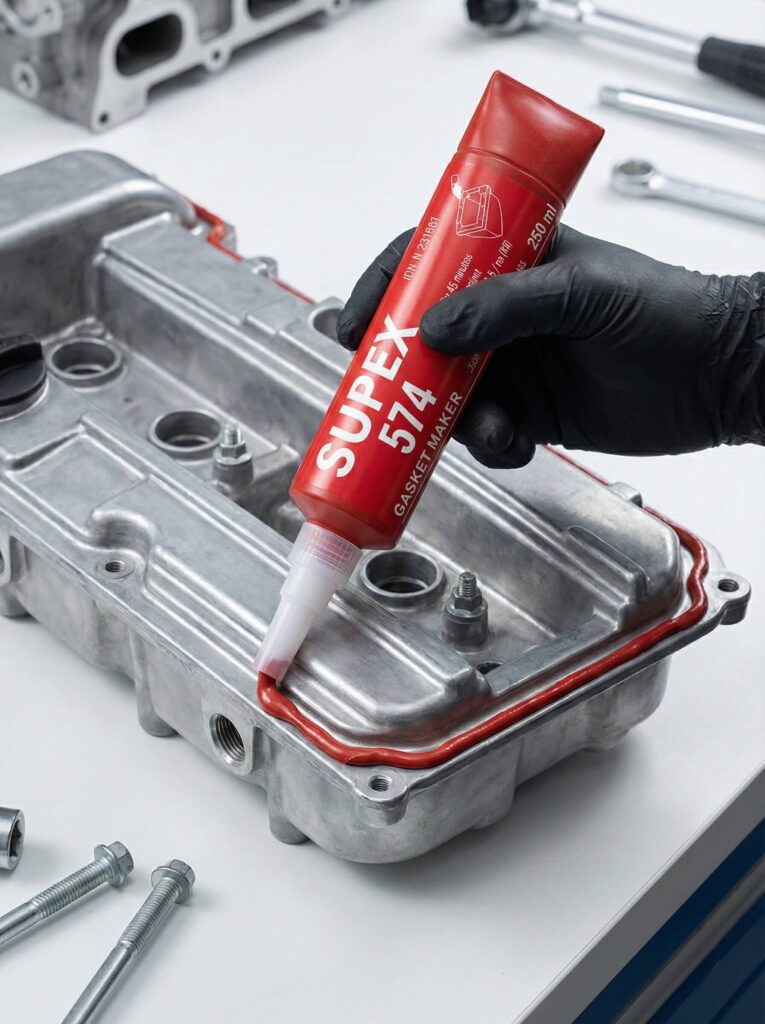
How to Apply Gasket Sealant: Step-by-Step Guide
Correct application is just as important as product selection. Follow these steps to help create a reliable seal.
Step 1: Prepare the Surfaces
Remove the old gasket and any remaining sealant. Clean both mating surfaces to remove oil, grease, dust, and debris.
Use a suitable cleaner that will not damage the materials. Allow the surfaces to dry completely.
Tip: Avoid scratching or damaging the flange faces while removing old gasket material.
Step 2: Check the Joint
Inspect the surfaces for corrosion, cracks, warping, and deep scratches.
Sealant cannot reliably repair a badly damaged flange or compensate for a gap beyond its rated limits. Replace damaged parts or correct the underlying problem before assembly.
Step 3: Apply the Sealant
Apply a continuous, even bead to the specified sealing area.
Follow the product instructions for bead size, placement, and coverage. Avoid applying too much sealant, as excess material may squeeze into the assembly.
For an anaerobic sealant, follow the instructions for the specific flange design. For RTV silicone, apply the bead and assemble the joint within the recommended working time.
Step 4: Assemble the Parts
Align the mating surfaces carefully. Install the fasteners and tighten them in the sequence and to the torque specified by the equipment manufacturer.
Do not overtighten the bolts. Excessive tightening can distort the joint and cause sealing problems.
Step 5: Allow the Sealant to Cure
Give the sealant enough time to cure before exposing the joint to operating pressure, oil, coolant, or other fluids.
Curing time varies with the formulation, bead thickness, temperature, humidity, and materials being joined.
Do not assume that a surface that feels dry is fully cured. Follow the product’s technical data sheet.
Step 6: Inspect the Joint
After the specified curing period, inspect the joint for signs of leakage.
Where appropriate, test the assembly using the equipment manufacturer’s approved procedure. If leakage continues, investigate the cause rather than simply adding more sealant.
Common Gasket Sealant Application Mistakes
Avoid these common mistakes to improve sealing performance:
Applying sealant over dirty surfaces: Oil, grease, and dust can prevent proper adhesion.
Using the wrong type: RTV silicone and anaerobic sealants have different curing requirements.
Applying too much product: Excess sealant can squeeze into internal passages.
Ignoring curing time: Premature exposure to fluids or pressure may cause seal failure.
Overtightening fasteners: Excessive force can distort the mating surfaces.
Using sealant where a gasket is required: Some joints require a specified gasket or another sealing method. Follow the equipment manufacturer’s instructions.
How to Choose the Best Gasket Sealant
Before purchasing a gasket sealant, consider these five factors.
1. Operating Temperature
Check the minimum and maximum temperatures the joint will experience, including short-term temperature spikes.
For high-temperature applications, choose a product rated for the actual operating conditions.
2. Chemical Compatibility
Identify the fluid or gas that the sealant will contact.
Engine oil, coolant, fuel, hydraulic fluid, and industrial chemicals can affect sealants differently. Confirm compatibility using the product data sheet.
3. Surface Material and Fit
Determine whether the joint consists of cast metal, sheet metal, or closely machined metal surfaces.
RTV silicone and anaerobic sealants have different requirements for surface fit and gap filling.
4. Pressure and Movement
Consider the operating pressure, vibration, and thermal expansion of the assembly.
A sealant designed for a static, low-pressure joint may not be suitable for a high-pressure system.
5. Curing Time and Maintenance Needs
Check how long the sealant needs to cure before the equipment can return to service.
If the assembly must be dismantled regularly, consider whether the selected product is appropriate for future maintenance.
Recommended Supex Gasket Sealant Products
The following products are useful starting points when comparing sealing solutions. Always confirm the application requirements before selecting a product.
Supex 280 High Temperature RTV Silicone Sealant
Suitable for compatible high-temperature gasketing and sealing applications, including certain automotive and industrial assemblies.
Supex 574 Flange Sealant
Designed for compatible metal flange joints where an anaerobic sealing solution is required.
Explore the Supex Product Range
Compare available adhesives and sealants to find a product suited to your application.
Browse Supex Industrial Adhesives and Sealants
If you are unsure which product is appropriate, share the joint material, operating temperature, fluid type, and application with the Supex team for guidance.
Frequently Asked Questions About Gasket Sealant
1. What is gasket sealant used for?
Gasket sealant prevents fluids and gases from leaking through compatible joints. It fills small gaps and surface imperfections in applications such as engines, gearboxes, pumps, and industrial machinery.
2. Can gasket sealant replace a traditional gasket?
Yes, some liquid gasket sealants are designed to replace conventional gaskets. However, not every joint supports this method. Always follow the equipment manufacturer’s specifications.
3. What is the difference between RTV and anaerobic gasket sealant?
RTV silicone cures through a reaction with moisture and forms a flexible seal. Anaerobic sealant cures in confined spaces between closely fitted metal surfaces. The correct choice depends on the joint design and operating conditions.
4. How long does gasket sealant take to cure?
Curing time depends on the product and application. Some sealants form a surface skin quickly but need much longer to cure fully. Follow the manufacturer’s instructions before adding fluids or applying pressure.
5. Can I use gasket sealant with a rubber gasket?
Sometimes. Certain sealants can be used with compatible rubber gaskets, but others may affect the gasket material or interfere with its sealing function. Use a sealant only when the gasket or equipment manufacturer approves it.
6. Is gasket sealant resistant to engine oil?
Some gasket sealants are designed to resist engine oil, but resistance varies by formulation, temperature, and exposure conditions. Check the product data sheet before using a sealant inside an engine assembly.
7. Can I apply new gasket sealant over an old layer?
In most applications, remove the old sealant and clean the surfaces before applying a fresh layer. Applying new material over contaminated or deteriorated sealant can lead to leaks.
8. Which gasket sealant is best for high-temperature applications?
The best option depends on the temperature range, joint design, and fluid exposure. A product such as Supex 280 is rated for temperatures up to 300°C, but you should verify that its specifications match the intended application.
Conclusion
The right gasket sealant helps prevent leaks, protect equipment, and reduce maintenance problems. However, reliable sealing depends on choosing a compatible product, preparing the surfaces properly, applying the correct amount, and allowing adequate curing time.
For flexible, high-temperature sealing applications, consider Supex 280 RTV Silicone Sealant. For closely fitted metal flanges, explore Supex 574 Flange Sealant.
Need help selecting a gasket sealant? Visit the Supex industrial adhesives and sealants range to explore available products and find a suitable solution for your equipment.
3 Responses
Thanks for providing this blog related to liquid-gasket-sealant. You have explained each & everything like how to use and involved in which applications.
thank you for the blog