
Best Metal to Metal Adhesive: Types, Comparison & Selection Guide
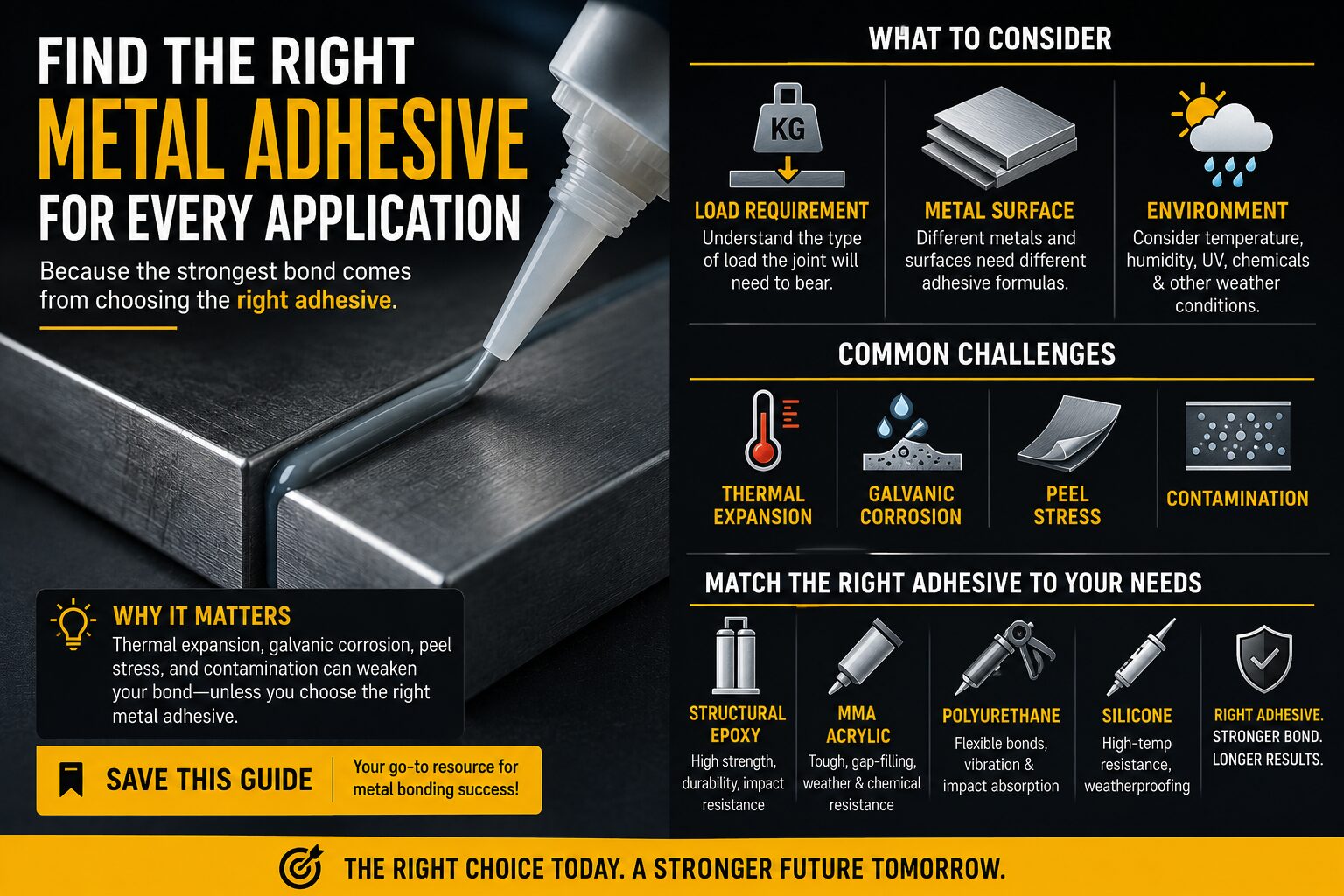
Choosing the best metal to metal adhesive depends on more than bond strength. The right adhesive must suit your metals, joint design, operating temperature, and working environment.
For example, a rigid epoxy may suit a stable assembly, while a structural MMA adhesive may be better for a joint exposed to impact or vibration. Flexible adhesives may suit panels that expand, contract, or move during use.
This guide compares the main types of metal adhesives, explains when to use each one, and helps you select a suitable option for your application. It also introduces relevant Supex products for industrial bonding.
What Is a Metal-to-Metal Adhesive?
A metal-to-metal adhesive joins two metal surfaces without relying only on welding, screws, rivets, or bolts.
Depending on its formulation, an adhesive can create a rigid structural joint or a flexible bond. Some products are designed for load-bearing assemblies, while others are intended for sealing, threadlocking, or panel bonding.
Common applications include:
Automotive and transport components
Metal fabrication and industrial equipment
Sheet-metal panels and enclosures
Construction panels and fittings
Electrical cabinets and machinery
Assemblies made from different metals
The first step is to identify the job the adhesive must perform. A structural adhesive, a flexible sealant, and a threadlocker are not interchangeable.
Types of Metal-to-Metal Adhesives
1. Structural MMA Adhesives
Methyl methacrylate (MMA) adhesives are two-part structural adhesives used in demanding bonding applications. Depending on the formulation, they can offer high strength, impact resistance, and resistance to vibration.
They can also bond certain dissimilar materials, such as metal and composite, when the product is approved for those substrates.
Consider MMA when you need:
A structural bond for industrial assembly
Resistance to impact and repeated loading
Bonding of compatible dissimilar materials
A practical alternative to welding in suitable designs
Supex products to consider:
Select the grade based on the required strength, working time, substrate compatibility, and service conditions.
2. Structural Epoxy Adhesives
Structural epoxies are often suitable for rigid bonds where strength, dimensional stability, or chemical resistance matters.
Their properties vary by formulation. Some grades are designed for metal assemblies, while others are intended for precision bonding or electrical applications.
Consider epoxy when you need:
A rigid, stable joint
Bonding for suitable industrial components
Resistance to selected chemicals
A controlled assembly process with an appropriate curing period
Supex product to consider: Supex E 30CL Structural Epoxy.
Check its technical data sheet to confirm the suitable substrates, strength requirements, and operating temperature.
3. Polyurethane (PU) Adhesives
Polyurethane adhesives can provide a tough, flexible bond. This flexibility may help accommodate movement and vibration in suitable assemblies.
Consider PU when you need:
Flexible bonding of metal panels
Bonding in applications exposed to movement
A suitable adhesive for selected outdoor assemblies
A bond that can accommodate differences in thermal expansion
Explore the Supex PU adhesive range for available grades.
4. MS Polymer Adhesives
MS polymer adhesives are commonly used for flexible bonding and sealing. They may be suitable where a joint needs to accommodate movement or resist weather exposure.
Consider MS polymer when you need:
Flexible bonding and sealing
Suitable panel or construction joints
Resistance to outdoor weathering
A joint that must accommodate movement
Explore the Supex adhesive and sealant range to find suitable products.
MS polymer adhesives are not automatically suitable for load-bearing structural joints. Check their intended use before selecting one.
5. Cyanoacrylate (Instant) Adhesives
Cyanoacrylate adhesives, often called instant adhesives, can bond small metal components quickly.
They are useful for selected small parts and assembly tasks, but many grades have limited gap-filling ability and may be unsuitable for joints exposed to sustained loads, impact, or harsh environments.
Consider cyanoacrylate when you need:
Fast bonding of small components
Minimal gap between the surfaces
A suitable adhesive for light-duty assembly
For structural metal joints, evaluate a dedicated structural adhesive instead.
6. Anaerobic Adhesives
Anaerobic adhesives cure when confined between close-fitting metal surfaces with limited exposure to air. They are commonly used for threaded fasteners, cylindrical components, and flanges.
Different grades serve different purposes.
| Product type | Typical purpose |
|---|---|
| Threadlocker | Helps prevent threaded fasteners from loosening |
| Retaining compound | Secures close-fitting cylindrical components |
| Thread sealant | Seals compatible threaded connections |
| Flange sealant | Seals suitable mating flange surfaces |
Anaerobic adhesives are specialised assembly products, not general-purpose gap-filling structural adhesives.
Metal Adhesive Selection Table: Which Type Should You Choose?
Use this decision table to narrow down your options based on the main requirement.
| Your main requirement | Adhesive type to consider | Why it may suit the job |
|---|---|---|
| Structural metal bonding | MMA or suitable structural epoxy | Designed for demanding bonded joints |
| Impact and vibration resistance | Suitable structural MMA | Some grades combine strength with toughness |
| Rigid bonding and dimensional stability | Structural epoxy | Cures to a relatively rigid bond |
| Flexible metal panel bonding | PU adhesive | Can accommodate movement |
| Flexible bonding and weather sealing | MS polymer | Suitable grades combine adhesion with elasticity |
| Fast bonding of small parts | Cyanoacrylate | Many grades develop handling strength quickly |
| Preventing threaded fasteners from loosening | Anaerobic threadlocker | Cures in confined threaded joints |
| Sealing close-fitting flanges | Anaerobic flange sealant | Designed for suitable mating surfaces |
This table is a starting point, not a guarantee of suitability. Always check the product specifications and test critical joints under representative conditions.
How to Choose the Best Metal-to-Metal Adhesive
Before choosing a product, answer these six questions.
1. Which metals are you joining?
Identify the substrates, such as mild steel, stainless steel, aluminium, or galvanized steel.
If the metals have paint, plating, anodizing, or another coating, check whether the adhesive can bond to that finish. The coating itself may be the weakest part of the joint.
2. What load must the joint withstand?
Consider whether the joint will experience:
Shear: force acting along the bonded surface
Tension: force pulling the parts apart
Peel: force lifting the adhesive from an edge
Impact: a sudden force
Cyclic loading: repeated stress during use
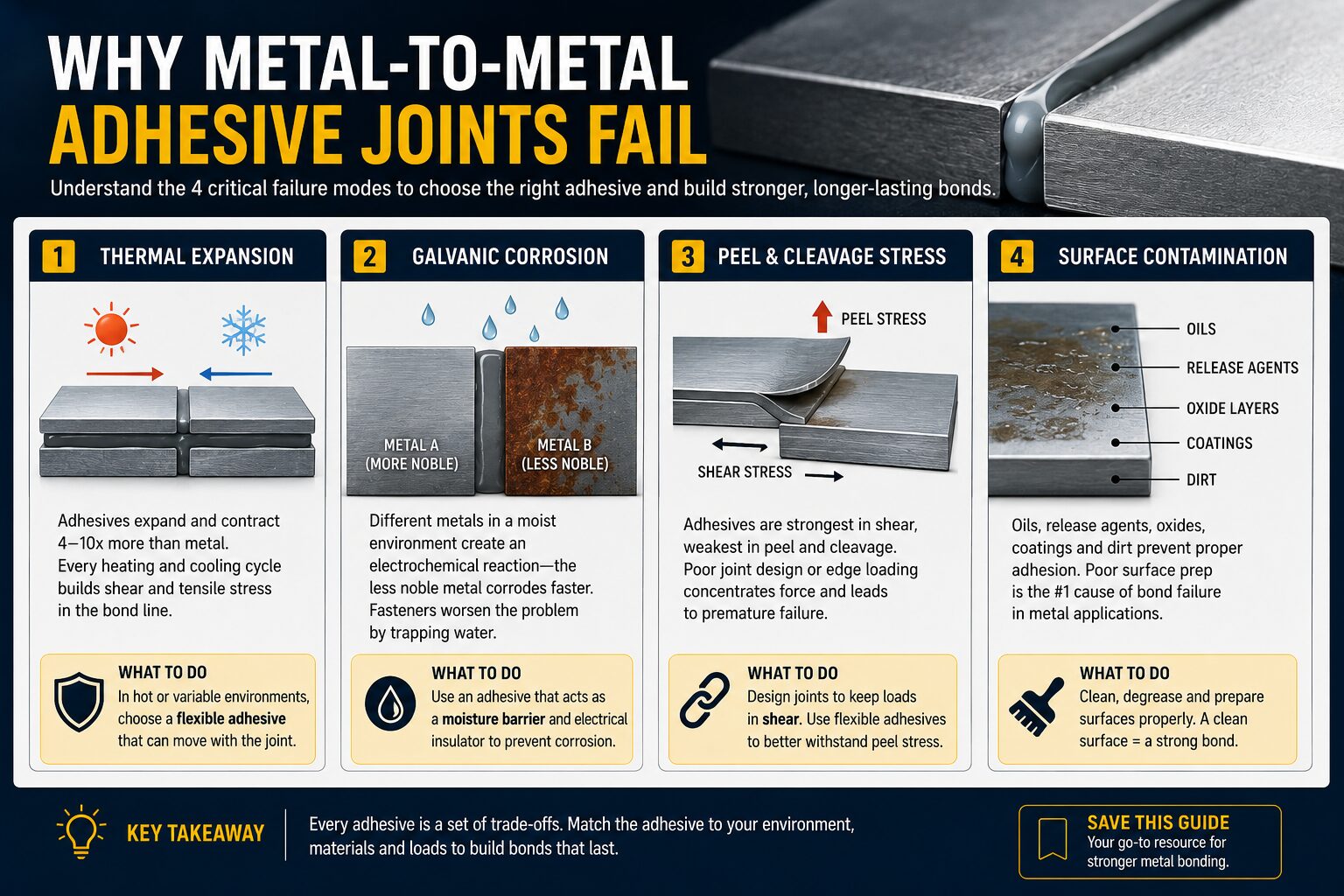
A strong adhesive cannot compensate for a poorly designed joint. Where possible, design the assembly to distribute loads across the bonded area and reduce concentrated peel forces.
3. Will the joint move or vibrate?
A rigid adhesive may suit a stable assembly. A tougher or more flexible adhesive may be more appropriate when components experience vibration, impact, or repeated expansion and contraction.
4. What temperatures will the joint experience?
Check both the application temperature and the maximum and minimum service temperatures.
Do not assume that all epoxy adhesives tolerate more heat than every MMA or other structural adhesive. Compare the actual product ratings.
5. Will the joint face water or chemicals?
Consider humidity, rain, salt exposure, cleaning products, oils, and industrial chemicals.
Choose an adhesive with documented resistance to the conditions the joint will experience.
6. How quickly must the assembly be ready?
Check the adhesive’s working time, fixture time, and full-cure time.
A fast fixture time can help production efficiency, but the joint may need longer to reach its specified final properties. Follow the manufacturer’s curing instructions.
Supex Metal Bonding Products to Explore
The following products are starting points for evaluation. The best choice depends on your joint design, substrate, and operating conditions.
Supex 3090 MMA Adhesive
A two-part structural MMA adhesive intended for bonding metals, plastics, and composite assemblies.
Explore it for: Structural bonding applications where toughness, impact resistance, and fatigue performance are important.
Supex M419 Structural Adhesive – Metal Bonder
A structural methacrylate adhesive designed for demanding bonding applications involving suitable metals and other compatible substrates.
Explore it for: Industrial assembly where structural strength and resistance to dynamic loads are important.
Supex GP0416 Structural MMA Adhesive
A general-purpose structural MMA adhesive for suitable metal, composite, and engineered-plastic applications.
Explore it for: Structural bonding where impact resistance and substrate compatibility are key considerations.
Supex E 30CL Structural Epoxy
A two-part structural epoxy used for suitable metal bonding and other precision assembly applications.
Explore it for: Applications that need a rigid bond and the properties specified for this epoxy grade.
View Supex E 30CL Structural Epoxy
For other adhesive technologies, explore the complete Supex bonding adhesive range.
Surface Preparation for Metal Bonding
Even the right adhesive can fail if the surface is poorly prepared.
Follow the preparation instructions for your selected product.
Clean the surface. Remove oil, grease, dust, and other contaminants using a compatible cleaner.
Remove loose material. Remove rust, scale, and weak coatings where the product instructions permit.
Abrade if required. Some adhesives need a prepared or lightly abraded surface.
Remove dust. Make sure no loose particles remain on the bonding area.
Check the surface. Confirm that it is dry and ready for bonding.
Follow the product instructions. Use the correct mixing ratio, application method, bond-line thickness, and curing conditions.
Do not assume that every adhesive tolerates oily or unprepared metal. Surface preparation requirements differ by formulation.
For detailed guidance on choosing and applying a metal adhesive, read the Supex metal glue guide.
Metal Adhesive vs Welding: When Should You Use Each?
Adhesive bonding can be a useful alternative to welding in selected applications, but neither method is best for every joint.
| Factor | Adhesive bonding | Welding |
|---|---|---|
| Heat input | Generally avoids welding heat | Uses heat to join metals |
| Thin sheet metal | Can reduce heat-related distortion | Heat can cause distortion |
| Joint design | Bonds across a designed surface area | Creates a fused joint |
| Dissimilar materials | Some adhesives bond compatible combinations | May require specialised joining methods |
| Surface preparation | Requires preparation suited to the adhesive | Requires preparation suited to the welding process |
| Service limits | Depend on adhesive chemistry and joint design | Depend on weld quality and materials |
Welding may remain necessary for certain high-temperature, heavy structural, safety-critical, or regulated applications. Evaluate the complete assembly before choosing a joining method.
For the manufacturing perspective, read Metal Bonding Adhesive: An Alternative to Welding and Fasteners.
Common Metal Adhesive Selection Mistakes
Avoid these common mistakes:
Choosing an adhesive based only on a headline strength value
Ignoring the type and direction of the applied load
Assuming all metals need the same surface preparation
Using a flexible sealant for a structural joint without verification
Ignoring service temperature and chemical exposure
Confusing fixture time with full cure
Skipping validation for critical assemblies
Selecting the right adhesive requires matching the product to the complete application, not just the substrate.
Frequently Asked Questions
What is the best metal-to-metal adhesive?
The best metal-to-metal adhesive depends on the substrate, load, joint design, temperature, and environment. MMA adhesives and structural epoxies are options for suitable structural applications, while PU and MS polymer adhesives may suit flexible joints.
Is epoxy or MMA better for bonding metal?
Neither is best for every application. Structural epoxies may suit rigid bonds, while some MMA adhesives offer a useful combination of strength, toughness, and impact resistance. Compare the technical specifications for the specific grades.
What is the strongest glue for metal to metal?
There is no single strongest adhesive for all metal joints. Tensile strength, lap-shear strength, peel resistance, impact performance, and durability measure different properties. Select an adhesive based on the actual joint and loading conditions.
Can adhesive bond steel to aluminium?
Some structural adhesives can bond steel to aluminium. Confirm compatibility with both substrates and consider thermal expansion and galvanic corrosion risks, particularly in wet environments.
Can I use metal adhesive instead of welding?
In suitable applications, adhesive bonding can replace welding or reduce the need for mechanical fasteners. However, some joints still require welding or other approved joining methods because of load, temperature, safety, or regulatory requirements.
How do I prepare metal before applying adhesive?
Clean the surfaces, remove loose rust or material where permitted, and abrade if the product requires it. Remove dust and follow the manufacturer’s instructions for mixing, application, and curing.
How long does metal adhesive take to cure?
Cure time varies by adhesive chemistry, formulation, temperature, and bond thickness. Check the working time, fixture time, and full-cure time in the product documentation.
Which Supex adhesive should I choose?
Supex offers structural MMA adhesives, epoxy adhesives, and other bonding technologies. Share your metal types, joint design, load requirements, operating temperature, and environmental conditions with the Supex team to help identify a suitable grade.
Find the Best Metal-to-Metal Adhesive for Your Application
The best adhesive is the one that matches your substrate, load, joint design, and service conditions.
For structural metal bonding, explore Supex 3090 MMA Adhesive, Supex M419 Structural Adhesive, and Supex E 30CL Structural Epoxy.
You can also browse the complete Supex bonding adhesive range.
Need help choosing a product? Contact Supex with your substrate details, application, and performance requirements to discuss a suitable solution.